
Join Our JEE Preparation Group
Prep with like-minded aspirants; Get access to free daily tests and study material.
Sign in
Please select an account to continue using cracku.in
↓ →
Join Our JEE Preparation Group
Prep with like-minded aspirants; Get access to free daily tests and study material.
The natural number $$m$$, for which the coefficient of $$x$$ in the binomial expansion of $$\left(x^m + \frac{1}{x^2}\right)^{22}$$ is 1540, is
Correct Answer: 13
We look at the binomial expansion of $$\left(x^m+\dfrac{1}{x^{2}}\right)^{22}$$.
The general ((k+1)-th) term in this expansion is obtained from the formula $$T_{k+1}=^{22}C_{k}\,(x^{m})^{\,22-k}\left(\dfrac{1}{x^{2}}\right)^{k}.$$
Simplifying the powers of $$x$$ we get $$T_{k+1}=^{22}C_{k}\,x^{\,m(22-k)}\;x^{-2k}=^{22}C_{k}\,x^{\,m(22-k)-2k}.$$
We are told that the coefficient of $$x^{1}$$ (i.e. of the term in which the power of $$x$$ is $$1$$) equals $$1540$$. Hence we must have
Power condition: $$m(22-k)-2k=1.$$
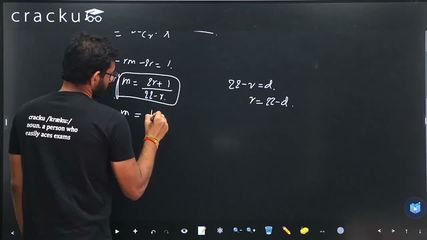
Re-arranging, $$m=\dfrac{1+2k}{22-k}$$ where $$k$$ can take integral values from $$0$$ to $$22$$.
For $$m$$ to be a natural number, the denominator $$22-k$$ must divide the numerator $$1+2k$$ exactly. Put $$d=22-k\;(\Rightarrow k=22-d)$$ with $$d=1,2,\dots ,22$$. Substituting,
$$m=\dfrac{1+2(22-d)}{d}=\dfrac{45-2d}{d}=\,\dfrac{45}{d}-2.$$
Thus $$d$$ has to be a positive divisor of $$45$$ not exceeding $$22$$. The admissible values of $$d$$ and the corresponding $$m$$ are
$$ \begin{aligned} d=1&:;; m=45-2=43,\\ d=3&:;; m=15-2=13,\\ d=5&:;; m=9-2=7,\\ d=9&:;; m=5-2=3,\\ d=15&:;; m=3-2=1. \end{aligned} $$
We now check the coefficient of each candidate term, remembering that the coefficient is $$^{22}C_{k}$$ with $$k=22-d$$:
$$ \begin{aligned} d=1&\Rightarrow k=21:\;^{22}C_{21}=^{22}C_{1}=22,\\ d=3&\Rightarrow k=19:\;^{22}C_{19}=^{22}C_{3}=1540,\\ d=5&\Rightarrow k=17:\;^{22}C_{17}=^{22}C_{5}=26334,\\ d=9&\Rightarrow k=13:\;^{22}C_{13}=497420,\\ d=15&\Rightarrow k=7:\;^{22}C_{7}=170544. \end{aligned} $$
The required coefficient is $$1540$$, which occurs only when $$d=3$$ (equivalently $$k=19$$). For this value we have already found $$m=13$$.
So, the answer is $$13$$.
Was this solution helpful?
Click on the Email ☝️ to Watch the Video Solution
Create a FREE account and get:
_1.webp)

Educational materials for JEE preparation

Ask our AI anything

AI can make mistakes. Please verify important information.
AI can make mistakes. Please verify important information.


