
Join Our JEE Preparation Group
Prep with like-minded aspirants; Get access to free daily tests and study material.
Sign in
Please select an account to continue using cracku.in
↓ →
Join Our JEE Preparation Group
Prep with like-minded aspirants; Get access to free daily tests and study material.
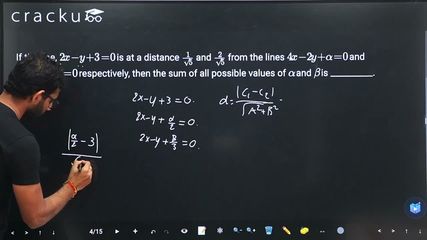
If the line, $$2x - y + 3 = 0$$ is at a distance $$\frac{1}{\sqrt{5}}$$ and $$\frac{2}{\sqrt{5}}$$ from the lines $$4x - 2y + \alpha = 0$$ and $$6x - 3y + \beta = 0$$ respectively, then the sum of all possible values of $$\alpha$$ and $$\beta$$ is __________.
Correct Answer: 30
We have the given line $$2x - y + 3 = 0$$ and two other lines $$4x - 2y + \alpha = 0$$ and $$6x - 3y + \beta = 0$$ which are both obviously parallel to the first line because their left-hand sides are constant multiples of $$2x - y$$. For parallel lines we use the formula for the perpendicular distance between the pair of lines
$$\text{Distance} \;=\; \frac{\lvert C_1 - C_2\rvert}{\sqrt{A^{2} + B^{2}}},$$
where the lines are written in the common normal form $$Ax + By + C_1 = 0$$ and $$Ax + By + C_2 = 0$$.
First we compare the first line with $$4x - 2y + \alpha = 0$$. To make the two equations share the same normal vector, we divide the entire second equation by $$2$$:
$$\frac{4x - 2y + \alpha}{2} = 0 \;\;\Longrightarrow\;\; 2x - y + \frac{\alpha}{2} = 0.$$
Now both lines are in the form $$2x - y + C = 0$$, so we can directly apply the distance formula. The required distance is given to be $$\dfrac{1}{\sqrt{5}}$$, and the denominator $$\sqrt{A^{2} + B^{2}}$$ equals $$\sqrt{2^{2} + (-1)^{2}} = \sqrt{5}$$. Substituting these into the formula we get
$$\frac{\lvert 3 - \dfrac{\alpha}{2}\rvert}{\sqrt{5}} = \frac{1}{\sqrt{5}} \;\;\Longrightarrow\;\; \lvert 3 - \dfrac{\alpha}{2}\rvert = 1.$$
This absolute-value equation splits into two linear equations:
1. $$3 - \dfrac{\alpha}{2} = 1 \;\;\Longrightarrow\;\; \dfrac{\alpha}{2} = 2 \;\;\Longrightarrow\;\; \alpha = 4,$$
2. $$3 - \dfrac{\alpha}{2} = -1 \;\;\Longrightarrow\;\; \dfrac{\alpha}{2} = 4 \;\;\Longrightarrow\;\; \alpha = 8.$$
Hence the possible values of $$\alpha$$ are $$4$$ and $$8$$.
Next we compare $$2x - y + 3 = 0$$ with the line $$6x - 3y + \beta = 0$$. We again normalise by dividing by $$3$$:
$$\frac{6x - 3y + \beta}{3} = 0 \;\;\Longrightarrow\;\; 2x - y + \frac{\beta}{3} = 0.$$
The distance between these two parallel lines is stated to be $$\dfrac{2}{\sqrt{5}}$$. Using the same denominator $$\sqrt{5}$$, we write
$$\frac{\lvert 3 - \dfrac{\beta}{3}\rvert}{\sqrt{5}} = \frac{2}{\sqrt{5}} \;\;\Longrightarrow\;\; \lvert 3 - \dfrac{\beta}{3}\rvert = 2.$$
Again we split the absolute value:
1. $$3 - \dfrac{\beta}{3} = 2 \;\;\Longrightarrow\;\; \dfrac{\beta}{3} = 1 \;\;\Longrightarrow\;\; \beta = 3,$$
2. $$3 - \dfrac{\beta}{3} = -2 \;\;\Longrightarrow\;\; \dfrac{\beta}{3} = 5 \;\;\Longrightarrow\;\; \beta = 15.$$
Thus the possible values of $$\beta$$ are $$3$$ and $$15$$.
The problem asks for the sum of all possible values of $$\alpha$$ and $$\beta$$ together. Adding these distinct values we get
$$\underbrace{4 + 8}_{\alpha\text{-values}} + \underbrace{3 + 15}_{\beta\text{-values}} = 12 + 18 = 30.$$
Hence, the correct answer is 30.
Was this solution helpful?
Click on the Email ☝️ to Watch the Video Solution
Create a FREE account and get:
_1.webp)

Educational materials for JEE preparation

Ask our AI anything

AI can make mistakes. Please verify important information.
AI can make mistakes. Please verify important information.


