
Join Our JEE Preparation Group
Prep with like-minded aspirants; Get access to free daily tests and study material.
Sign in
Please select an account to continue using cracku.in
↓ →
Join Our JEE Preparation Group
Prep with like-minded aspirants; Get access to free daily tests and study material.
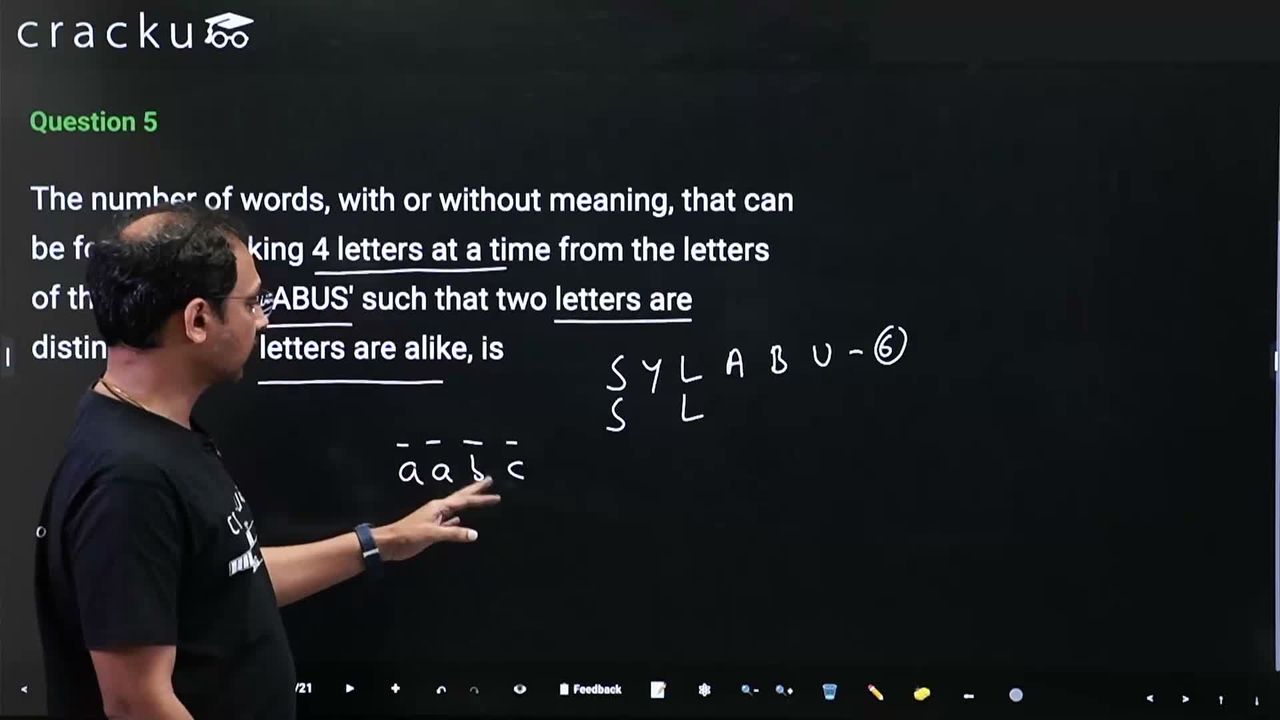
The number of words, with or without meaning, that can be formed by taking 4 letters at a time from the letters of the word 'SYLLABUS' such that two letters are distinct and two letters are alike, is
Correct Answer: 240
First, we list the letters in the word ‘SYLLABUS’. We have $$S,\,Y,\,L,\,L,\,A,\,B,\,U,\,S$$. So, the multiset of letters contains $$S$$ twice, $$L$$ twice, and $$Y,\,A,\,B,\,U$$ each once.
We want to form 4-letter words in which exactly two letters are alike (a pair) and the remaining two letters are different from each other and from the repeated letter. Symbolically we need a pattern of the type $$a\,a\,b\,c$$ with $$b\neq c\neq a$$.
Step 1: choose the letter that appears twice. Only letters that occur at least twice in ‘SYLLABUS’ can serve this role. Those are $$S$$ and $$L$$. Hence, the repeated letter can be chosen in $$2$$ ways.
Step 2: choose the two distinct letters $$b$$ and $$c$$ from the remaining letters, making sure they are different from each other and from the repeated letter.
If the repeated letter is $$S$$, the available distinct types are $$\{Y,\,L,\,A,\,B,\,U\}$$, i.e. 5 different letters. The number of ways to pick any two of them is the combination $$\binom{5}{2}=10.$$
If the repeated letter is $$L$$, the remaining distinct types are $$\{S,\,Y,\,A,\,B,\,U\}$$, again 5 letters, giving $$\binom{5}{2}=10$$ ways.
So, the total number of choices for the 4-letter multiset $$\{a,a,b,c\}$$ is $$2\times 10 = 20.$$
Step 3: arrange the chosen letters. For any specific selection $$a,a,b,c$$, we must count all permutations of these four symbols where the two $$a$$’s are indistinguishable but $$b$$ and $$c$$ are distinguishable. The permutation formula for a multiset says $$\text{Number of permutations}=\dfrac{4!}{2!}=12,$$ because we divide by $$2!$$ to account for the identical pair of $$a$$’s.
Step 4: multiply the number of selections by the number of arrangements: $$20 \times 12 = 240.$$
So, the answer is $$240$$.
Was this solution helpful?
Click on the Email ☝️ to Watch the Video Solution
Create a FREE account and get:
_1.webp)

Educational materials for JEE preparation

Ask our AI anything

AI can make mistakes. Please verify important information.
AI can make mistakes. Please verify important information.


