
Join Our JEE Preparation Group
Prep with like-minded aspirants; Get access to free daily tests and study material.
Sign in
Please select an account to continue using cracku.in
↓ →
Join Our JEE Preparation Group
Prep with like-minded aspirants; Get access to free daily tests and study material.
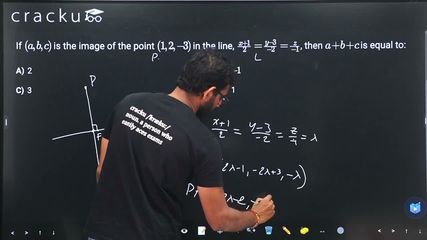
If $$(a, b, c)$$ is the image of the point $$(1, 2, -3)$$ in the line, $$\frac{x+1}{2} = \frac{y-3}{-2} = \frac{z}{-1}$$, then $$a + b + c$$ is equal to:
Let us denote the given point as $$P(1, 2, -3)$$, and let $$F$$ be the foot of the perpendicular dropped from $$P$$ onto the given straight line.
The equation of the given line is:
$$\frac{x+1}{2} = \frac{y-3}{-2} = \frac{z}{-1} = \lambda$$
Any general point on this line can represent the coordinates of the foot $$F$$ in terms of the scalar parameter $$\lambda$$:
$$F = (2\lambda - 1, -2\lambda + 3, -\lambda)$$
Now, let us find the direction ratios of the line segment $$PF$$ by subtracting the coordinates of point $$P$$ from point $$F$$:
$$\text{Direction Ratios of } PF = ((2\lambda - 1) - 1, (-2\lambda + 3) - 2, -\lambda - (-3))$$
$$\text{Direction Ratios of } PF = (2\lambda - 2, -2\lambda + 1, -\lambda + 3)$$
The direction ratios of the given line are the denominators of the symmetric equation, which are $$(2, -2, -1)$$. Since the line segment $$PF$$ is perpendicular to the given line, the dot product of their direction ratios must equal zero:
$$2(2\lambda - 2) + (-2)(-2\lambda + 1) + (-1)(-\lambda + 3) = 0$$
Expanding the terms and simplifying the equation:
$$(4\lambda - 4) + (4\lambda - 2) + (\lambda - 3) = 0$$
$$4\lambda + 4\lambda + \lambda - 4 - 2 - 3 = 0$$
$$9\lambda - 9 = 0 \implies 9\lambda = 9 \implies \lambda = 1$$
Substitute the value of $$\lambda = 1$$ back into our expression for the foot $$F$$ to find its exact coordinates:
$$F = (2(1) - 1, -2(1) + 3, -(1)) = (1, 1, -1)$$
The image point is given as $$I(a, b, c)$$. Geometrically, the foot of the perpendicular $$F$$ acts exactly as the midpoint of the line segment connecting the original point $$P$$ to its image $$I$$.
Using the midpoint formula:
$$F = \frac{P + I}{2} \implies I = 2F - P$$
Let us calculate each coordinate of the image point $$(a, b, c)$$ separately:
$$a = 2(1) - 1 = 1$$
$$b = 2(1) - 2 = 0$$
$$c = 2(-1) - (-3) = -2 + 3 = 1$$
Thus, the coordinates of the image point are $$(a, b, c) = (1, 0, 1)$$.
The question asks for the value of $$a + b + c$$:
$$a + b + c = 1 + 0 + 1 = 2$$
Was this solution helpful?
Click on the Email ☝️ to Watch the Video Solution
Create a FREE account and get:
_1.webp)

Educational materials for JEE preparation

Ask our AI anything

AI can make mistakes. Please verify important information.
AI can make mistakes. Please verify important information.


