
Join Our JEE Preparation Group
Prep with like-minded aspirants; Get access to free daily tests and study material.
Sign in
Please select an account to continue using cracku.in
↓ →
Join Our JEE Preparation Group
Prep with like-minded aspirants; Get access to free daily tests and study material.
The total number of unpaired electrons present in the $$d^3$$, $$d^4$$ (low spin), $$d^5$$ (high spin), $$d^6$$ (high spin), and $$d^7$$ (low spin) octahedral complexes systems is :
Correct Answer: 15
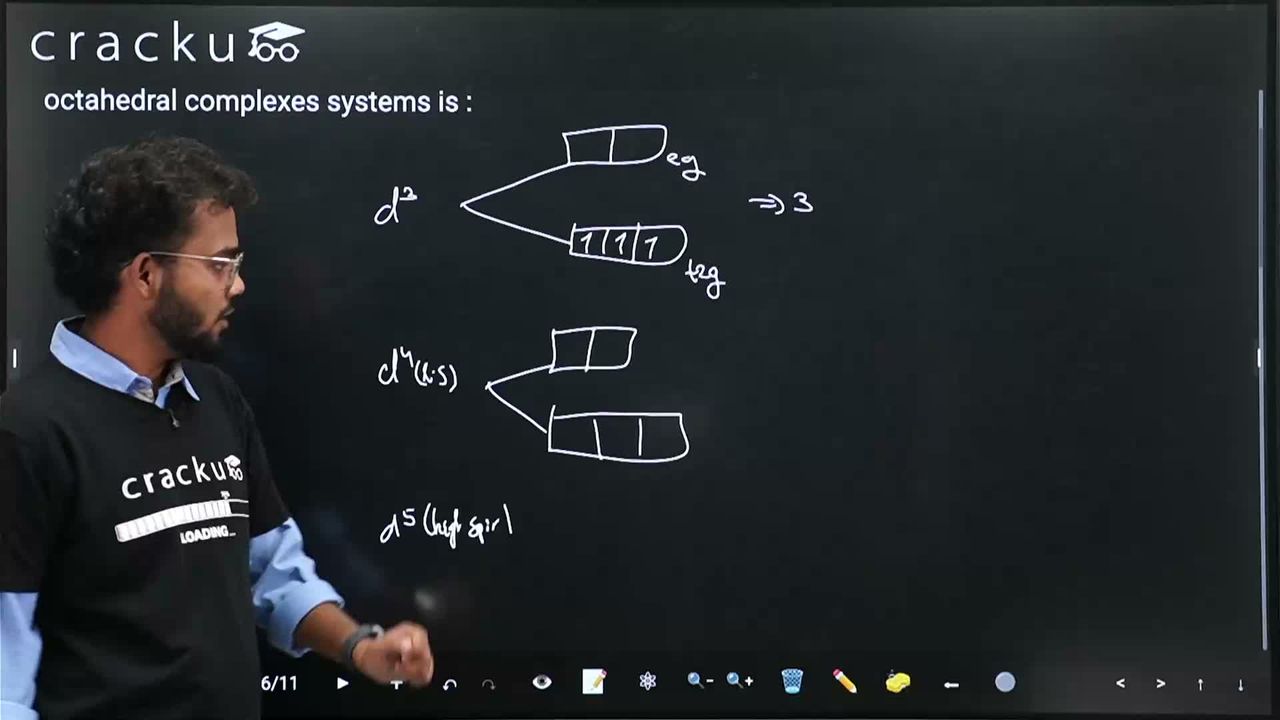
To determine the total number of unpaired electrons in the given octahedral systems, we use Crystal Field Theory (CFT) to distribute the $$d$$-electrons into the $$t_{2g}$$ and $$e_g$$ orbitals according to whether the complex is high spin or low spin.
For the $$d^3$$ configuration, the electrons occupy the three $$t_{2g}$$ orbitals singly, giving the arrangement $$t_{2g}^3e_g^0$$. Therefore, the number of unpaired electrons is $$3$$.
For the low-spin $$d^4$$ configuration, the fourth electron pairs in one of the $$t_{2g}$$ orbitals, resulting in the configuration $$t_{2g}^4e_g^0$$. Hence, the number of unpaired electrons is $$2$$.
For the high-spin $$d^5$$ configuration, the electrons occupy all five available orbitals singly before pairing, giving $$t_{2g}^3e_g^2$$. Thus, the number of unpaired electrons is $$5$$.
For the high-spin $$d^6$$ configuration, the sixth electron pairs in one of the $$t_{2g}$$ orbitals, resulting in $$t_{2g}^4e_g^2$$. Therefore, the number of unpaired electrons is $$4$$.
For the low-spin $$d^7$$ configuration, all six electrons first fill the $$t_{2g}$$ orbitals, and the seventh electron occupies an $$e_g$$ orbital, giving $$t_{2g}^6e_g^1$$. Hence, the number of unpaired electrons is $$1$$.
The total number of unpaired electrons is
$$\text{Total}=3+2+5+4+1=15.$$
Therefore, the total number of unpaired electrons in the given systems is $$15$$.
Click on the Email ☝️ to Watch the Video Solution
Create a FREE account and get:
_1.webp)

Educational materials for JEE preparation

Ask our AI anything

AI can make mistakes. Please verify important information.
AI can make mistakes. Please verify important information.


