
Join Our JEE Preparation Group
Prep with like-minded aspirants; Get access to free daily tests and study material.
Sign in
Please select an account to continue using cracku.in
↓ →
Join Our JEE Preparation Group
Prep with like-minded aspirants; Get access to free daily tests and study material.
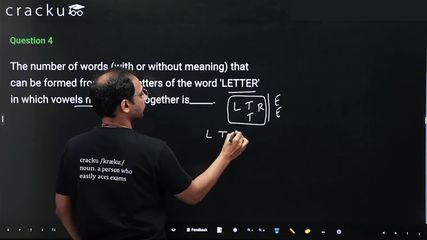
The number of words (with or without meaning) that can be formed from all the letters of the word 'LETTER' in which vowels never come together is_____.
Correct Answer: 120
The given word is ‘LETTER’. We first note the individual letters and how many times each appears:
$$L : 1,\; E : 2,\; T : 2,\; R : 1.$$
We want to count all possible arrangements (words) of these six letters in which the two vowels (both $$E$$’s) are never next to each other.
We begin by finding the total number of arrangements of all six letters without any restriction. The general formula for permutations of $$n$$ objects where some objects repeat is stated first:
$$\text{If } n_1, n_2, \ldots, n_k$$ are the repetition counts, then $$\dfrac{n!}{n_1!\,n_2!\,\ldots\,n_k!}.$$
Here, out of the six letters, the letter $$E$$ repeats $$2$$ times and the letter $$T$$ repeats $$2$$ times. Therefore,
Total unrestricted arrangements $$= \dfrac{6!}{2!\,2!}.$$
Using the factorial definition $$n! = n \times (n-1) \times \cdots \times 1,$$ we have
$$6! = 720,\qquad 2! = 2.$$
Substituting, we get
$$\dfrac{6!}{2!\,2!}= \dfrac{720}{2 \times 2}= \dfrac{720}{4}=180.$$
Now we must subtract those arrangements in which the two vowels come together. To enforce “togetherness,” we tie the two $$E$$’s into a single super-letter $$\bigl(EE\bigr).$$ Treating this super-letter as one entity, the objects we must arrange are
$$(EE),\,L,\,T,\,T,\,R.$$
That is a total of $$5$$ objects, with $$T$$ repeating twice. Using the same repetition formula, the number of arrangements with the two vowels side by side is
$$\dfrac{5!}{2!}.$$
Again, evaluate:
$$5! = 120,\qquad 2! = 2,$$
so
$$\dfrac{5!}{2!}= \dfrac{120}{2}=60.$$
Finally, to get the arrangements in which the vowels are never together, we subtract the “together” count from the total:
$$\text{Required number}= 180 - 60 = 120.$$
So, the answer is $$120$$.
Was this solution helpful?
Click on the Email ☝️ to Watch the Video Solution
Create a FREE account and get:
_1.webp)

Educational materials for JEE preparation

Ask our AI anything

AI can make mistakes. Please verify important information.
AI can make mistakes. Please verify important information.


