
Join Our JEE Preparation Group
Prep with like-minded aspirants; Get access to free daily tests and study material.
Sign in
Please select an account to continue using cracku.in
↓ →
Join Our JEE Preparation Group
Prep with like-minded aspirants; Get access to free daily tests and study material.
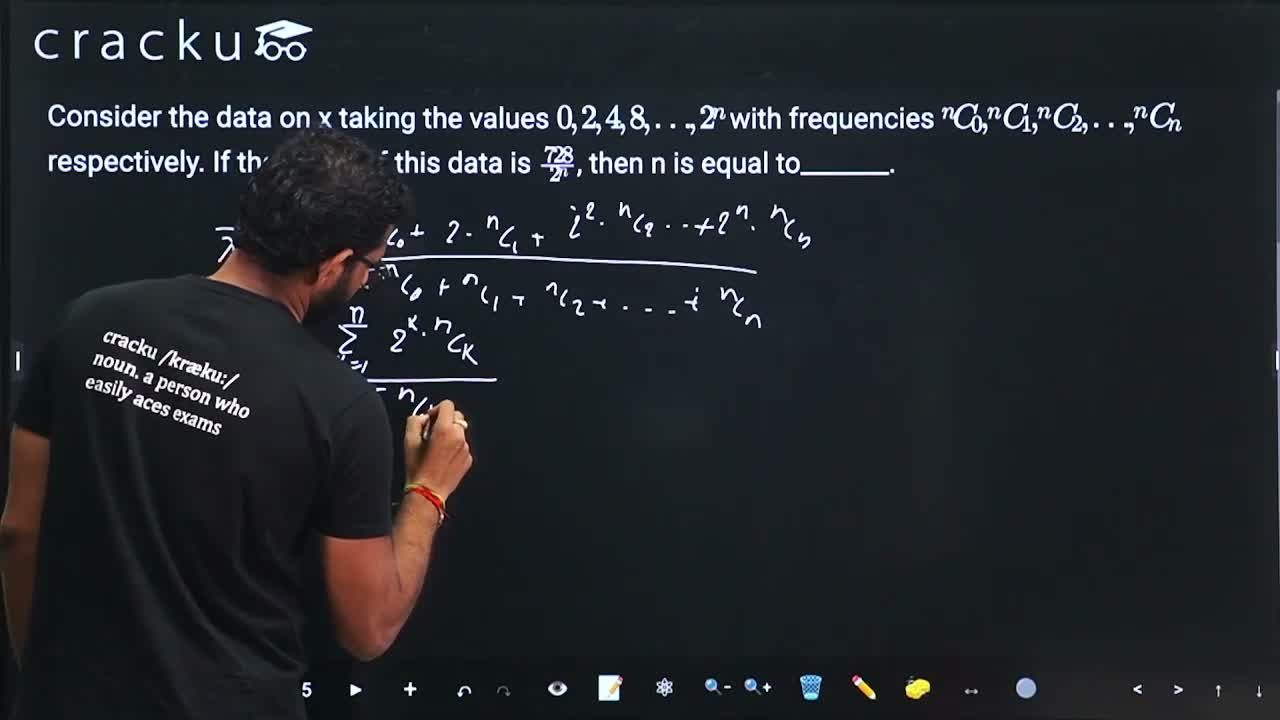
Consider the data on x taking the values $$0, 2, 4, 8, \ldots, 2^n$$ with frequencies $$^nC_0, ^nC_1, ^nC_2, \ldots, ^nC_n$$ respectively. If the mean of this data is $$\frac{728}{2^n}$$, then n is equal to_______.
Correct Answer: 6
We have a grouped data set where the variable $$x$$ takes the values $$0,2,4,8,\ldots ,2^n$$ and the corresponding frequencies are $$^nC_0,\,^nC_1,\,^nC_2,\ldots ,^nC_n$$.
The mean (arithmetic average) of any discrete distribution is given by the well-known formula
$$\text{Mean}\;=\;\frac{\displaystyle \sum (\text{value})\times(\text{frequency})}{\displaystyle \sum (\text{frequency})}.$$
First we evaluate the denominator. By the Binomial Theorem,
$$\sum_{k=0}^{n} {^nC_k}=2^{\,n},$$
because it is the expansion of $$(1+1)^n.$$ Hence the total of all frequencies equals $$2^{\,n}.$$
The question itself tells us that the mean is
$$\frac{728}{2^{\,n}}.$$
Comparing this with the definition of the mean, we see that the numerator of the fraction, namely the sum of the products of each value with its frequency, must therefore be $$728$$. Symbolically,
$$\sum_{k=0}^{n} (\text{value})\times(\text{frequency}) \;=\;728.$$
Now let us compute this numerator explicitly. Observe that except for the first value $$0$$, every other value is a power of $$2$$ that matches its index in the combination:
$$\begin{aligned} \text{Numerator} &=\;0\cdot {^nC_0} \;+\; 2\cdot{^nC_1}\;+\;4\cdot{^nC_2}\;+\;8\cdot{^nC_3}\;+\;\ldots+\;2^{\,n}\cdot{^nC_n}\\[4pt] &=\;\sum_{k=1}^{n} 2^{\,k}\,{^nC_k}. \end{aligned}$$
To evaluate this sum, we again use the Binomial Theorem. For any real number $$a,$$
$$\sum_{k=0}^{n} {^nC_k}a^{\,k} = (1+a)^{n}.$$
Choosing $$a=2,$$ we get
$$\sum_{k=0}^{n} {^nC_k}2^{\,k} = (1+2)^{n}=3^{\,n}.$$
Notice that the left-hand side includes the term with $$k=0,$$ which is $$2^{\,0}{^nC_0}=1\cdot1=1.$$ Therefore,
$$\sum_{k=1}^{n} 2^{\,k}{^nC_k}=3^{\,n}-1.$$
But this is exactly the numerator we need, and we already equated that numerator to $$728$$. Hence
$$3^{\,n}-1 = 728.$$
Adding $$1$$ to both sides gives
$$3^{\,n}=729.$$
We recognize $$729$$ as a power of $$3$$ because $$3^{6}=729.$$ Therefore,
$$n=6.$$
So, the answer is $$6$$.
Was this solution helpful?
Click on the Email ☝️ to Watch the Video Solution
Create a FREE account and get:
_1.webp)

Educational materials for JEE preparation

Ask our AI anything

AI can make mistakes. Please verify important information.
AI can make mistakes. Please verify important information.


