
Join Our JEE Preparation Group
Prep with like-minded aspirants; Get access to free daily tests and study material.
Sign in
Please select an account to continue using cracku.in
↓ →
Join Our JEE Preparation Group
Prep with like-minded aspirants; Get access to free daily tests and study material.
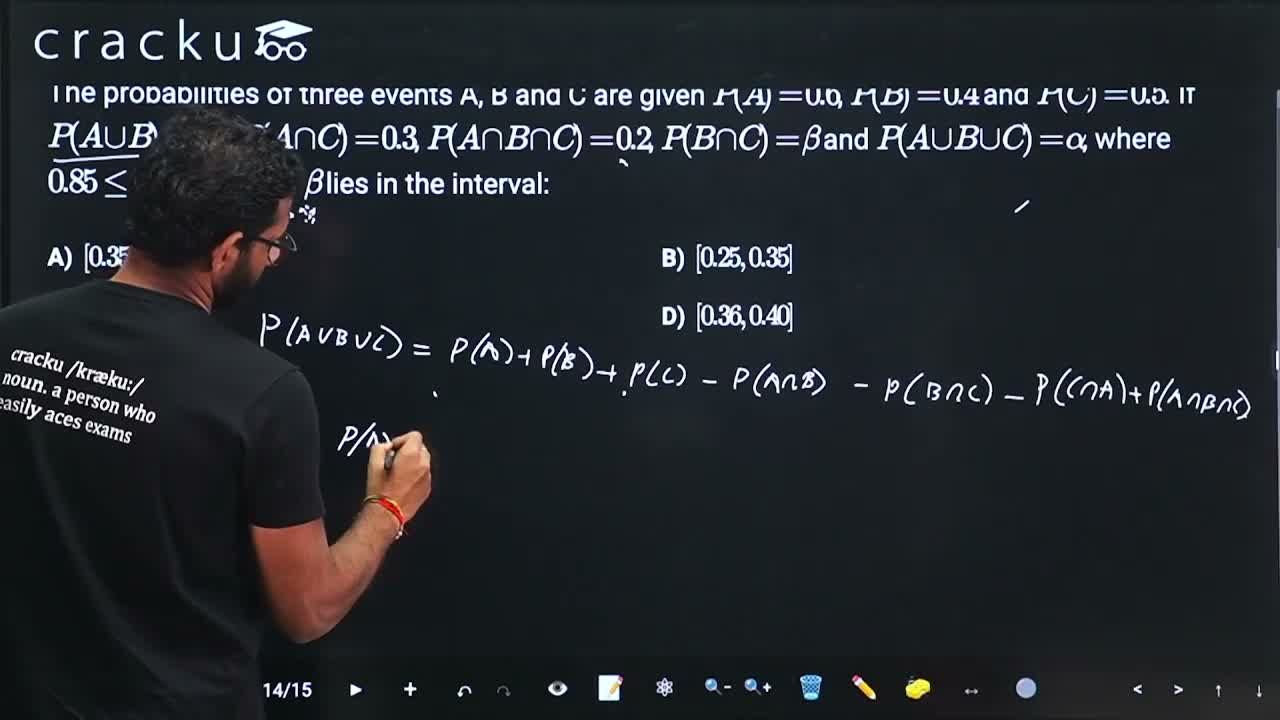
The probabilities of three events A, B and C are given $$P(A) = 0.6$$, $$P(B) = 0.4$$ and $$P(C) = 0.5$$. If $$P(A \cup B) = 0.8$$, $$P(A \cap C) = 0.3$$, $$P(A \cap B \cap C) = 0.2$$, $$P(B \cap C) = \beta$$ and $$P(A \cup B \cup C) = \alpha$$, where $$0.85 \leq \alpha \leq 0.95$$, then $$\beta$$ lies in the interval:
We have the individual probabilities
$$P(A)=0.6,\qquad P(B)=0.4,\qquad P(C)=0.5.$$
First, from the union of A and B we can determine their intersection. The addition (union) rule of two events is
$$P(A\cup B)=P(A)+P(B)-P(A\cap B).$$
Substituting the given numbers,
$$0.8 = 0.6 + 0.4 - P(A\cap B).$$
So
$$P(A\cap B)=0.6+0.4-0.8 = 0.2.$$
The triple intersection is given directly:
$$P(A\cap B\cap C)=0.2.$$
The intersection of A and C is also supplied:
$$P(A\cap C)=0.3.$$
Let us denote
$$\beta = P(B\cap C),\qquad \alpha = P(A\cup B\cup C).$$
To involve $$\beta$$ and $$\alpha$$ simultaneously, we invoke the general addition (union) rule for three events:
$$P(A\cup B\cup C)=P(A)+P(B)+P(C)-P(A\cap B)-P(A\cap C)-P(B\cap C)+P(A\cap B\cap C).$$
Substituting every known value step by step,
$$\alpha = 0.6 + 0.4 + 0.5 \;-\; 0.2 \;-\; 0.3 \;-\; \beta \;+\; 0.2.$$
Simplifying the numeric part carefully,
$$\alpha = 1.5 - 0.2 - 0.3 - \beta + 0.2 = 1.2 - \beta.$$
The problem states that $$\alpha$$ must satisfy
$$0.85 \le \alpha \le 0.95.$$
Replacing $$\alpha$$ by $$1.2-\beta$$, we obtain the compound inequality
$$0.85 \le 1.2 - \beta \le 0.95.$$
We solve each side separately.
Left-hand side:
$$0.85 \le 1.2 - \beta \;\;\Longrightarrow\;\; -\beta \le 1.2 - 0.85 = 0.35 \;\;\Longrightarrow\;\; \beta \le 0.35.$$
Right-hand side:
$$1.2 - \beta \le 0.95 \;\;\Longrightarrow\;\; -\beta \le 0.95 - 1.2 = -0.25 \;\;\Longrightarrow\;\; \beta \ge 0.25.$$
Combining the two inequalities we get
$$0.25 \le \beta \le 0.35.$$
Finally, we should check that this range is also permissible with elementary constraints such as
$$\beta \le P(B)=0.4,\qquad \beta \le P(C)=0.5,\qquad \beta \ge P(A\cap B\cap C)=0.2,$$
all of which are clearly satisfied by every value in the interval $$[0.25,0.35]$$.
Therefore $$\beta$$ must lie in the interval $$[0.25,0.35].$$
Among the given choices, this corresponds precisely to Option B.
Hence, the correct answer is Option B.
Was this solution helpful?
Click on the Email ☝️ to Watch the Video Solution
Create a FREE account and get:
_1.webp)

Educational materials for JEE preparation

Ask our AI anything

AI can make mistakes. Please verify important information.
AI can make mistakes. Please verify important information.


