
Join Our JEE Preparation Group
Prep with like-minded aspirants; Get access to free daily tests and study material.
Sign in
Please select an account to continue using cracku.in
↓ →
Join Our JEE Preparation Group
Prep with like-minded aspirants; Get access to free daily tests and study material.
A plane P meets the coordinate axes at A, B and C respectively. The centroid of $$\triangle ABC$$ is given to be $$(1, 1, 2)$$. Then the equation of the line through this centroid and perpendicular to the plane P is:
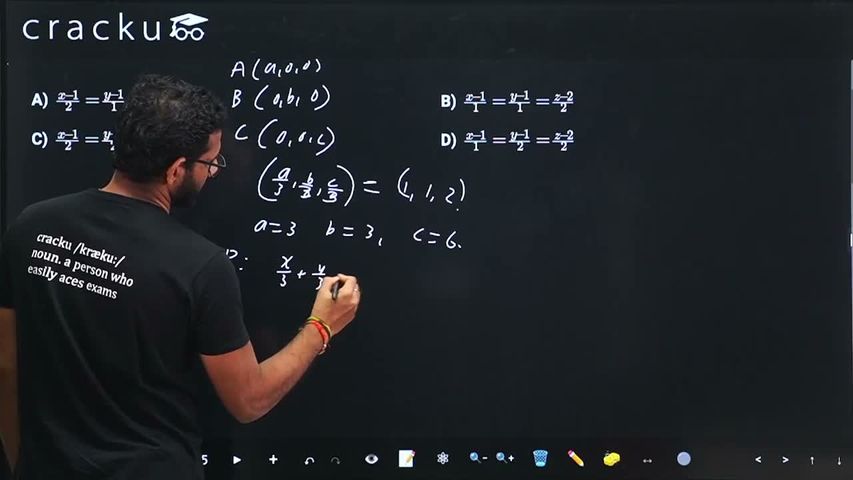
We have a plane $$P$$ that cuts the three coordinate axes at the points $$A(a,0,0),\;B(0,b,0),\;C(0,0,c).$$ Because these three points are on the axes, the line segments $$OA,\;OB,\;OC$$ (where $$O$$ is the origin) are the intercepts of the plane on the axes.
The centroid $$G$$ of a triangle whose vertices are $$(x_1,y_1,z_1),\;(x_2,y_2,z_2),\;(x_3,y_3,z_3)$$ is obtained by taking the arithmetic mean of the corresponding coordinates, that is,
$$G\;(x_G,y_G,z_G)=\left(\dfrac{x_1+x_2+x_3}{3},\; \dfrac{y_1+y_2+y_3}{3},\; \dfrac{z_1+z_2+z_3}{3}\right).$$
Applying this to the triangle $$\triangle ABC$$ we get
$$G\left(\dfrac{a+0+0}{3},\;\dfrac{0+b+0}{3}, \;\dfrac{0+0+c}{3}\right) \;=\;\left(\dfrac{a}{3},\;\dfrac{b}{3},\;\dfrac{c}{3}\right).$$
It is given that $$G=(1,1,2).$$ Hence we obtain three simple linear equations:
$$\dfrac{a}{3}=1\;\Longrightarrow\;a=3,$$ $$\dfrac{b}{3}=1\;\Longrightarrow\;b=3,$$ $$\dfrac{c}{3}=2\;\Longrightarrow\;c=6.$$
The intercept form of the equation of a plane is
$$\frac{x}{a}\;+\;\frac{y}{b}\;+\;\frac{z}{c}\;=\;1.$$
Substituting the values $$a=3,\;b=3,\;c=6$$ that we have just found, the required plane is
$$\frac{x}{3}\;+\;\frac{y}{3}\;+\;\frac{z}{6}=1.$$
Removing the denominators by multiplying by 6 gives
$$2x\;+\;2y\;+\;z\;=\;6.$$
For any plane written as $$Ax+By+Cz=D$$ the vector $$\vec n=(A,B,C)$$ is perpendicular to the plane and therefore provides the direction ratios of every line that is perpendicular (normal) to the plane.
Here $$A=2,\;B=2,\;C=1,$$ so one convenient set of direction ratios of the required line is $$2,\;2,\;1.$$
The symmetric form of a line that passes through a point $$(x_0,y_0,z_0)$$ and has direction ratios $$(l,m,n)$$ is
$$\frac{x-x_0}{l} \;=\; \frac{y-y_0}{m} \;=\; \frac{z-z_0}{n}.$$
Taking $$G(1,1,2)$$ as the point and the direction ratios $$2,2,1,$$ we write
$$\frac{x-1}{2}\;=\;\frac{y-1}{2}\;=\;\frac{z-2}{1}.$$
Hence, the correct answer is Option C.
Was this solution helpful?
Click on the Email ☝️ to Watch the Video Solution
Create a FREE account and get:
_1.webp)

Educational materials for JEE preparation

Ask our AI anything

AI can make mistakes. Please verify important information.
AI can make mistakes. Please verify important information.


