
Join Our JEE Preparation Group
Prep with like-minded aspirants; Get access to free daily tests and study material.
Sign in
Please select an account to continue using cracku.in
↓ →
Join Our JEE Preparation Group
Prep with like-minded aspirants; Get access to free daily tests and study material.
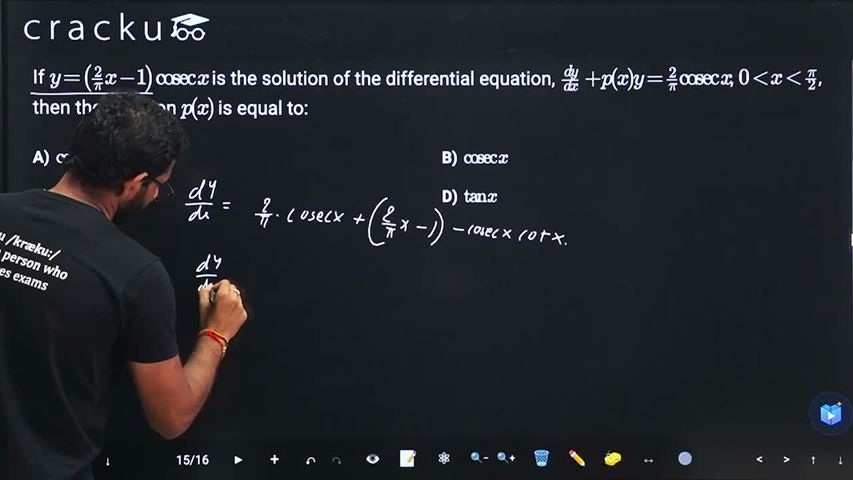
If $$y = \left(\frac{2}{\pi}x - 1\right) \operatorname{cosec} x$$ is the solution of the differential equation, $$\frac{dy}{dx} + p(x)y = \frac{2}{\pi} \operatorname{cosec} x$$, $$0 < x < \frac{\pi}{2}$$, then the function $$p(x)$$ is equal to:
We are given the explicit solution to the differential equation:
$$y = \left(\frac{2}{\pi}x - 1\right) \operatorname{cosec} x$$
To find $$p(x)$$, we first need to determine the derivative $$\frac{dy}{dx}$$ of this solution with respect to $$x$$. We apply the product rule of differentiation:
$$\frac{dy}{dx} = \frac{d}{dx}\left[\frac{2}{\pi}x - 1\right] \cdot \operatorname{cosec} x + \left(\frac{2}{\pi}x - 1\right) \cdot \frac{d}{dx}\left[\operatorname{cosec} x\right]$$
Evaluating the individual derivatives gives:
$$\frac{d}{dx}\left[\frac{2}{\pi}x - 1\right] = \frac{2}{\pi}$$
$$\frac{d}{dx}\left[\operatorname{cosec} x\right] = -\operatorname{cosec} x \operatorname{cot} x$$
Substituting these back into our product rule expression yields:
$$\frac{dy}{dx} = \frac{2}{\pi}\operatorname{cosec} x - \left(\frac{2}{\pi}x - 1\right)\operatorname{cosec} x \operatorname{cot} x$$
Now, we rewrite the second grouping of terms on the right side by recognizing that our original expression for $$y$$ is embedded within it:
$$\left(\frac{2}{\pi}x - 1\right)\operatorname{cosec} x = y$$
Substituting $$y$$ directly into the derivative equation simplifies it to:
$$\frac{dy}{dx} = \frac{2}{\pi}\operatorname{cosec} x - y \operatorname{cot} x$$
Rearranging the terms by bringing the component containing $$y$$ over to the left-hand side of the equality:
$$\frac{dy}{dx} + y \operatorname{cot} x = \frac{2}{\pi}\operatorname{cosec} x$$
Let us directly compare this structured equation with the standard form of the first-order linear differential equation provided in the question:
$$\frac{dy}{dx} + p(x)y = \frac{2}{\pi}\operatorname{cosec} x$$
By matching the corresponding coefficients of $$y$$ from both expressions, we can cleanly extract the unknown function:
$$p(x) = \operatorname{cot} x$$
Was this solution helpful?
Click on the Email ☝️ to Watch the Video Solution
Create a FREE account and get:
_1.webp)

Educational materials for JEE preparation

Ask our AI anything

AI can make mistakes. Please verify important information.
AI can make mistakes. Please verify important information.


