
Join Our JEE Preparation Group
Prep with like-minded aspirants; Get access to free daily tests and study material.
Sign in
Please select an account to continue using cracku.in
↓ →
Join Our JEE Preparation Group
Prep with like-minded aspirants; Get access to free daily tests and study material.
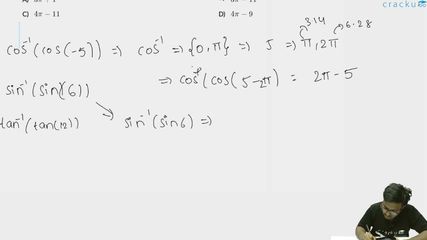
$$\cos^{-1}(\cos(-5)) + \sin^{-1}(\sin(6)) - \tan^{-1}(\tan(12))$$ is equal to:
(The inverse trigonometric functions take the principal values)
We have to compute the expression $$$\cos^{-1}(\cos(-5))+\sin^{-1}(\sin 6)-\tan^{-1}(\tan 12)$$$ where every inverse trigonometric function is to be taken in its principal value branch.
First, recall the principal value ranges:
$$$\cos^{-1}x\in[0,\pi],\qquad \sin^{-1}x\in\left[-\dfrac{\pi}{2},\dfrac{\pi}{2}\right],\qquad \tan^{-1}x\in\left(-\dfrac{\pi}{2},\dfrac{\pi}{2}\right).$$$
1. Evaluating $$\cos^{-1}(\cos(-5))$$
Because the cosine function is even, $$\cos(-5)=\cos 5.$$ However, the principal value of $$\cos^{-1}$$ must lie in $$[0,\pi].$$ Now $$5$$ radians exceeds $$\pi$$ (since $$\pi\approx3.14$$) but is less than $$2\pi$$. Using the identity $$\cos\theta=\cos(2\pi-\theta),$$ we write
$$\cos 5=\cos(2\pi-5).$$
The angle $$2\pi-5$$ clearly lies between $$0$$ and $$\pi$$ because $$0<2\pi-5<\pi.$$ Therefore
$$\cos^{-1}(\cos(-5))=2\pi-5.$$
2. Evaluating $$\sin^{-1}(\sin 6)$$
The angle $$6$$ radians is slightly less than $$2\pi$$, so it is in the interval $$(\pi,2\pi).$$ For such angles the sine is negative and we use the fact that
$$\sin\theta=\sin(\theta-2\pi).$$
Subtracting one full revolution gives
$$6-2\pi\;(\approx -0.283)\in\left[-\dfrac{\pi}{2},\dfrac{\pi}{2}\right].$$
Since this result already lies in the principal value range of $$\sin^{-1},$$ we have
$$\sin^{-1}(\sin 6)=6-2\pi.$$
3. Evaluating $$\tan^{-1}(\tan 12)$$
The tangent function has period $$\pi,$$ so we may subtract integer multiples of $$\pi$$ until we land in the interval $$\left(-\dfrac{\pi}{2},\dfrac{\pi}{2}\right).$$ Write $$12=n\pi+\alpha$$ with $$\alpha\in\left(-\dfrac{\pi}{2},\dfrac{\pi}{2}\right).$$
Dividing by $$\pi$$ we find $$\dfrac{12}{\pi}\approx3.82,$$ so choose $$n=4.$$ Then
$$\alpha=12-4\pi.$$
Numerically $$12-4\pi\approx -0.566,$$ which indeed lies between $$-\dfrac{\pi}{2}$$ and $$\dfrac{\pi}{2}.$$ Thus
$$$\tan 12=\tan(12-4\pi)\quad\text{and}\quad\tan^{-1}(\tan 12)=12-4\pi.$$$
4. Combining all three parts
Substituting the three principal values we obtained:
$$$\begin{aligned} \cos^{-1}(\cos(-5))+\sin^{-1}(\sin 6)-\tan^{-1}(\tan 12) &=(2\pi-5)+(6-2\pi)-(12-4\pi)\\ &=2\pi-5+6-2\pi-12+4\pi\\ &=(2\pi-2\pi+4\pi)+(-5+6-12)\\ &=4\pi-11. \end{aligned}$$$
Hence, the correct answer is Option C.
Click on the Email ☝️ to Watch the Video Solution
Create a FREE account and get:
_1.webp)

Educational materials for JEE preparation

Ask our AI anything

AI can make mistakes. Please verify important information.
AI can make mistakes. Please verify important information.


