
Join Our JEE Preparation Group
Prep with like-minded aspirants; Get access to free daily tests and study material.
Sign in
Please select an account to continue using cracku.in
↓ →
Join Our JEE Preparation Group
Prep with like-minded aspirants; Get access to free daily tests and study material.
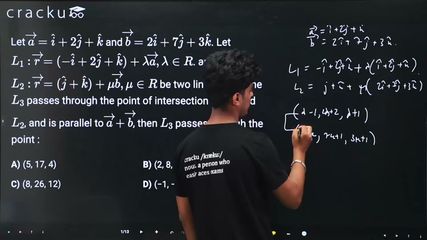
Let $$\overrightarrow{a}=\hat{i}+2\hat{j}+\hat{k}$$ and $$\overrightarrow{b}=2\hat{i}+7\hat{j}+3\hat{k}$$. Let $$L_{1}:\overrightarrow{r}=(-\hat{i}+2\hat{j}+\hat{k})+\lambda \overrightarrow{a},\lambda \in R$$. and $$L_{2}: \overrightarrow{r}=(\hat{j}+\hat{k})+\mu \overrightarrow{b}, \mu \in R$$ be two lines. If the line $$L_{3}$$ passes through the point of intersection of $$L_{1}$$ and $$L_{2}$$, and is parallel to $$\overrightarrow{a}+\overrightarrow{b}$$, then $$L_{3}$$ passes through the point :
We are given $$\vec{a} = \hat{i} + 2\hat{j} + \hat{k}$$ and $$\vec{b} = 2\hat{i} + 7\hat{j}+ 3\hat{k}$$, and the lines:
$$L_1: \vec{r} = (-\hat{i} + 2\hat{j} + \hat{k}) + \lambda\vec{a}$$
$$L_2: \vec{r} = (\hat{j} + \hat{k}) + \mu\vec{b}$$
Line $$L_3$$ passes through the intersection of $$L_1$$ and $$L_2$$ and is parallel to $$\vec{a} + \vec{b}$$.
Points on $$L_1$$ are given by $$(-1+\lambda,\;2+2\lambda,\;1+\lambda)$$ and points on $$L_2$$ by $$(2\mu,\;1+7\mu,\;1+3\mu)$$. Setting these equal gives:
$$-1+\lambda = 2\mu\,,\quad 2+2\lambda = 1+7\mu\,,\quad 1+\lambda = 1+3\mu$$
From the third equation $$\lambda = 3\mu$$, and substituting into the first yields $$-1+3\mu = 2\mu\implies \mu = 1$$ and hence $$\lambda = 3$$.
Verification in the second equation shows $$2+6=8$$ and $$1+7=8$$. The intersection point is therefore $$(-1+3,\;2+6,\;1+3) = (2,8,4)\,.$$
The direction of $$L_3$$ is the vector sum:
$$\vec{a} + \vec{b} = (1+2)\hat{i} + (2+7)\hat{j} + (1+3)\hat{k} = 3\hat{i} + 9\hat{j} + 4\hat{k}$$
The equation of $$L_3$$ can then be written in vector form as:
$$\vec{r} = (2\hat{i} + 8\hat{j} + 4\hat{k}) + t\,(3\hat{i} + 9\hat{j} + 4\hat{k})$$
with parametric form $$(2+3t,\;8+9t,\;4+4t)\,.$$
Checking which point lies on $$L_3$$, for $$(8,26,12)$$ we have $$2+3t=8\implies t=2$$, and then $$8+18=26$$ and $$4+8=12$$, so the choice is consistent. Thus the correct answer is Option 3: $$(8,26,12)\,.$$
Was this solution helpful?
Click on the Email ☝️ to Watch the Video Solution
Create a FREE account and get:
_1.webp)

Educational materials for JEE preparation

Ask our AI anything

AI can make mistakes. Please verify important information.
AI can make mistakes. Please verify important information.
