
Join Our JEE Preparation Group
Prep with like-minded aspirants; Get access to free daily tests and study material.
Sign in
Please select an account to continue using cracku.in
↓ →
Join Our JEE Preparation Group
Prep with like-minded aspirants; Get access to free daily tests and study material.
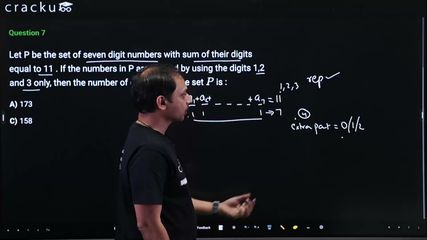
Let P be the set of seven digit numbers with sum of their digits equal to 11 . If the numbers in P are formed by using the digits 1,2 and 3 only, then the number of elements in the set $$P$$ is :
We need to find the number of 7-digit numbers formed using only digits 1, 2, and 3 such that the sum of digits equals 11.
Let the seven digits be $$x_1, x_2, \ldots, x_7$$ where each $$x_i \in \{1, 2, 3\}$$ and $$x_1 + x_2 + \cdots + x_7 = 11$$.
Let $$y_i = x_i - 1$$, so $$y_i \in \{0, 1, 2\}$$. Then:
$$ \sum_{i=1}^{7} (y_i + 1) = 11 \implies \sum_{i=1}^{7} y_i = 4 $$
We need to count the number of solutions to $$y_1 + y_2 + \cdots + y_7 = 4$$ where $$0 \leq y_i \leq 2$$.
Without the upper bound constraint, the number of non-negative integer solutions is $$\binom{4 + 7 - 1}{7 - 1} = \binom{10}{6} = 210$$.
Now subtract cases where any $$y_i \geq 3$$. If $$y_i \geq 3$$, let $$z_i = y_i - 3 \geq 0$$. Then the sum becomes $$z_i + \sum_{j \neq i} y_j = 1$$. The number of non-negative solutions is $$\binom{1 + 6}{6} = \binom{7}{6} = 7$$.
There are $$\binom{7}{1} = 7$$ ways to choose which variable exceeds 2, giving $$7 \times 7 = 49$$ cases.
No two variables can simultaneously be $$\geq 3$$ since that would require a sum $$\geq 6 > 4$$. So higher-order inclusion-exclusion terms are zero.
$$ N = 210 - 49 = 161 $$
The correct answer is Option 4: 161.
Was this solution helpful?
Click on the Email ☝️ to Watch the Video Solution
Create a FREE account and get:
_1.webp)

Educational materials for JEE preparation

Ask our AI anything

AI can make mistakes. Please verify important information.
AI can make mistakes. Please verify important information.
