
Join Our JEE Preparation Group
Prep with like-minded aspirants; Get access to free daily tests and study material.
Sign in
Please select an account to continue using cracku.in
↓ →
Join Our JEE Preparation Group
Prep with like-minded aspirants; Get access to free daily tests and study material.
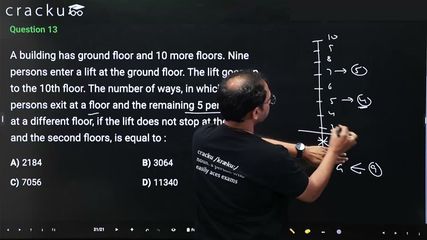
A building has ground floor and 10 more floors. Nine persons enter a lift at the ground floor. The lift goes up to the 10th floor. The number of ways, in which any 4 persons exit at a floor and the remaining 5 persons exit at a different floor, if the lift does not stop at the first and the second floors, is equal to :
The lift starts at the ground floor with all 9 passengers.
It is explicitly stated that the lift does not stop at the $$1^{\text{st}}$$ and $$2^{\text{nd}}$$ floors.
Therefore, the remaining available floors where people can exit are floors: $$3, 4, 5, 6, 7, 8, 9,$$ and $$10$$.
$$\text{Total available floors} = 10 - 2 = 8 \text{ floors}$$
We need to divide the 9 people into two groups: one group of 4 people and a remaining group of 5 people.
The number of ways to select 4 people out of 9 is: $$^9C_4 = \frac{9 \times 8 \times 7 \times 6}{4 \times 3 \times 2 \times 1} = 126$$
We need to choose 2 distinct floors out of the 8 available floors, where the first floor is for the group of 4 people and the second floor is for the group of 5 people.
Since the order matters (exiting at floor 3 vs floor 4 matters), this is an arrangement of 2 objects out of 8: $$^8P_2 = 8 \times 7 = 56$$
$$\text{Total ways} = {^9C_4} \times {^8P_2}$$
$$\text{Total ways} = 126 \times 56 = 7056$$
Was this solution helpful?
Click on the Email ☝️ to Watch the Video Solution
Create a FREE account and get:
_1.webp)

Educational materials for JEE preparation

Ask our AI anything

AI can make mistakes. Please verify important information.
AI can make mistakes. Please verify important information.
