
Join Our JEE Preparation Group
Prep with like-minded aspirants; Get access to free daily tests and study material.
Sign in
Please select an account to continue using cracku.in
↓ →
Join Our JEE Preparation Group
Prep with like-minded aspirants; Get access to free daily tests and study material.
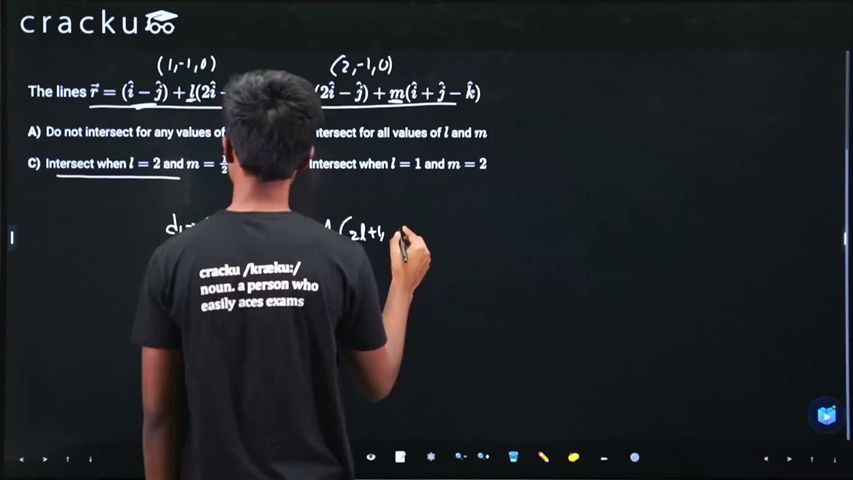
The lines $$\vec{r} = (\hat{i} - \hat{j}) + l(2\hat{i} + \hat{k})$$ and $$\vec{r} = (2\hat{i} - \hat{j}) + m(\hat{i} + \hat{j} - \hat{k})$$
We have two lines in vector form:
$$\vec{r} = (\hat{i} - \hat{j}) + l\,(2\hat{i} + \hat{k})$$
and
$$\vec{r} = (2\hat{i} - \hat{j}) + m\,(\hat{i} + \hat{j} - \hat{k}).$$
To decide whether the lines intersect, we assume that for some real numbers $$l$$ and $$m$$ the position vectors of a common point are equal. Hence we equate the corresponding Cartesian components.
First, we rewrite each vector equation in component form. Remember that $$\hat{i},\ \hat{j},\ \hat{k}$$ are unit vectors along the $$x, y, z$$ axes respectively.
For the first line:
$$\vec{r}_1 = (1)\hat{i} + (-1)\hat{j} + (0)\hat{k} + l\bigl(2\hat{i} + 0\hat{j} + 1\hat{k}\bigr).$$
So the coordinates of a general point on line 1 are
$$x_1 = 1 + 2l,\qquad y_1 = -1 + 0\cdot l = -1,\qquad z_1 = 0 + 1\cdot l = l.$$
For the second line:
$$\vec{r}_2 = (2)\hat{i} + (-1)\hat{j} + (0)\hat{k} + m\bigl(1\hat{i} + 1\hat{j} - 1\hat{k}\bigr).$$
Hence the coordinates of a general point on line 2 are
$$x_2 = 2 + m,\qquad y_2 = -1 + m,\qquad z_2 = 0 - m = -m.$$
If the two lines intersect, there must be values of $$l$$ and $$m$$ such that
$$x_1 = x_2,\quad y_1 = y_2,\quad z_1 = z_2.$$
Writing these three equations explicitly, we get
$$\begin{aligned} 1 + 2l &= 2 + m \quad &(1)\\[2pt] -1 &= -1 + m \quad &(2)\\[2pt] l &= -m \quad &(3) \end{aligned}$$
Now we solve this system step by step. From equation (2) we have
$$-1 = -1 + m \;\;\Longrightarrow\;\; m = 0.$$
Substituting $$m = 0$$ in equation (3) gives
$$l = -0 = 0.$$
Finally, we put $$l = 0$$ and $$m = 0$$ into equation (1):
$$1 + 2\cdot 0 = 2 + 0 \;\;\Longrightarrow\;\; 1 = 2,$$
which is clearly false. Hence the three equations cannot be satisfied simultaneously; there is no common point at any choice of $$l$$ and $$m$$.
Therefore the two given lines do not intersect for any values of $$l$$ and $$m$$.
Hence, the correct answer is Option A.
Was this solution helpful?
Click on the Email ☝️ to Watch the Video Solution
Create a FREE account and get:
_1.webp)

Educational materials for JEE preparation

Ask our AI anything

AI can make mistakes. Please verify important information.
AI can make mistakes. Please verify important information.
