
Join Our JEE Preparation Group
Prep with like-minded aspirants; Get access to free daily tests and study material.
Sign in
Please select an account to continue using cracku.in
↓ →
Join Our JEE Preparation Group
Prep with like-minded aspirants; Get access to free daily tests and study material.
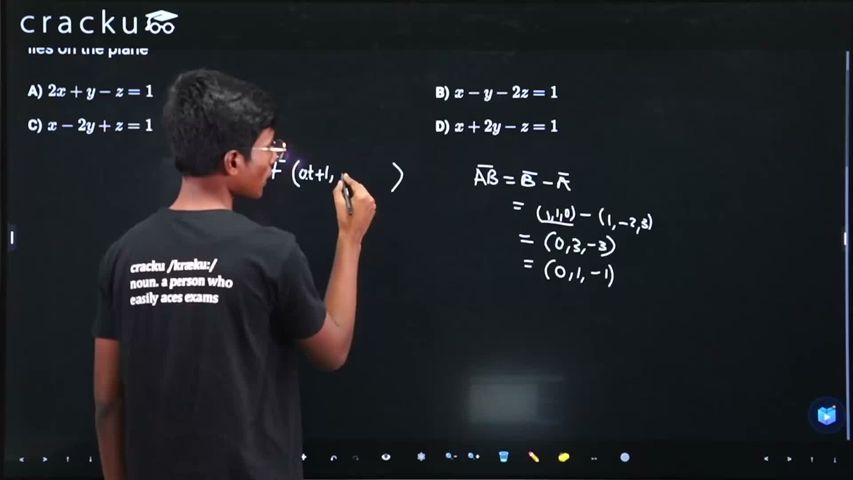
The foot of the perpendicular drawn from the point (4, 2, 3) to the line joining the points (1, -2, 3) and (1, 1, 0) lies on the plane
We have to locate the foot of the perpendicular from the point $$P(4,\,2,\,3)$$ to the line passing through the points $$A(1,\,-2,\,3)$$ and $$B(1,\,1,\,0).$$ After finding that foot, we shall substitute its coordinates into each of the four plane equations given in the options and see which one is satisfied.
First, let us write the vector equation of the line through $$A$$ and $$B.$$ The direction vector of the line is obtained by subtracting the position vectors of the two points:
$$\overrightarrow{AB} = B - A = (\,1-1,\;1-(-2),\;0-3\,) = (\,0,\;3,\,-3\,).$$
Hence any general point $$R$$ on the line can be written as
$$R(1,\,-2,\,3) + t(0,\,3,\,-3) \;=\; (\,1,\; -2 + 3t,\; 3 - 3t\,),$$
where $$t$$ is a real parameter.
Let $$H(1,\,-2+3t,\;3-3t)$$ be the foot of the perpendicular from $$P$$ to this line. By definition, the vector joining $$P$$ to $$H$$ is perpendicular to the direction vector of the line. The scalar‐product (dot product) of perpendicular vectors is zero, so we state the orthogonality condition:
Formula: If $$\vec{u}\cdot\vec{v}=0,$$ then vectors $$\vec{u}$$ and $$\vec{v}$$ are perpendicular.
Here $$\vec{u} = \overrightarrow{PH}$$ and $$\vec{v} = \overrightarrow{AB} = (0,\,3,\,-3).$$ Let us compute $$\overrightarrow{PH}$$ explicitly:
$$\overrightarrow{PH} = H - P = \big(1-4,\;(-2+3t)-2,\;(3-3t)-3\big) = (-3,\;-4+3t,\;-3t).$$
Now apply the perpendicularity (dot‐product zero) condition:
$$\overrightarrow{PH}\cdot\overrightarrow{AB} = (-3,\;-4+3t,\;-3t)\cdot(0,\,3,\,-3) = (-3)\times0 + (-4+3t)\times3 + (-3t)\times(-3) = 0.$$
Simplifying step by step, we have
$$(-4+3t)\times3 = -12 + 9t,$$
$$(-3t)\times(-3) = 9t,$$
so the dot product becomes
$$-12 + 9t + 9t = -12 + 18t.$$
Setting this equal to zero gives the equation
$$-12 + 18t = 0 \quad\Longrightarrow\quad 18t = 12 \quad\Longrightarrow\quad t = \dfrac{12}{18} = \dfrac{2}{3}.$$
Substituting $$t = \frac{2}{3}$$ back into the coordinates of $$H,$$ we get
$$x_H = 1,$$
$$y_H = -2 + 3\left(\dfrac{2}{3}\right) = -2 + 2 = 0,$$
$$z_H = 3 - 3\left(\dfrac{2}{3}\right) = 3 - 2 = 1.$$
Thus the foot of the perpendicular is the point $$H(1,\,0,\,1).$$
Now we check which of the four given plane equations is satisfied by $$H.$$ We substitute $$x = 1,\; y = 0,\; z = 1$$ into each option:
Option A: $$2x + y - z = 1 \;\;\Longrightarrow\;\; 2(1) + 0 - 1 = 2 - 1 = 1,$$ which is true.
Option B: $$x - y - 2z = 1 \;\;\Longrightarrow\;\; 1 - 0 - 2(1) = 1 - 2 = -1,$$ not satisfied.
Option C: $$x - 2y + z = 1 \;\;\Longrightarrow\;\; 1 - 0 + 1 = 2,$$ not satisfied.
Option D: $$x + 2y - z = 1 \;\;\Longrightarrow\;\; 1 + 0 - 1 = 0,$$ not satisfied.
Only Option A gives the correct result.
Hence, the correct answer is Option A.
Was this solution helpful?
Click on the Email ☝️ to Watch the Video Solution
Create a FREE account and get:
_1.webp)

Educational materials for JEE preparation

Ask our AI anything

AI can make mistakes. Please verify important information.
AI can make mistakes. Please verify important information.
