
Join Our JEE Preparation Group
Prep with like-minded aspirants; Get access to free daily tests and study material.
Sign in
Please select an account to continue using cracku.in
↓ →
Join Our JEE Preparation Group
Prep with like-minded aspirants; Get access to free daily tests and study material.
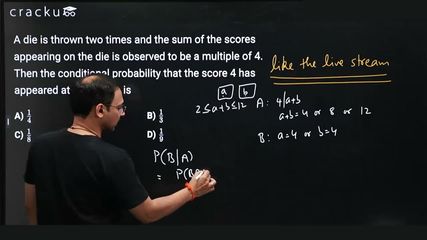
A die is thrown two times and the sum of the scores appearing on the die is observed to be a multiple of 4. Then the conditional probability that the score 4 has appeared at least once is
Let us denote by $$A$$ the event “the sum of the two throws is a multiple of 4” and by $$B$$ the event “the score 4 appears at least once”. We wish to find the conditional probability $$P(B\mid A)$$, that is, the probability of $$B$$ given that $$A$$ has already occurred.
By definition of conditional probability we have
$$P(B\mid A)=\dfrac{P(A\cap B)}{P(A)}.$$
First we list every ordered pair $$(x,y)$$, where $$x$$ is the first throw and $$y$$ is the second throw, that belongs to $$A$$. A sum is a multiple of 4 precisely when it equals $$4,8$$ or $$12$$, so we examine these three cases one by one.
For the sum $$4$$:
$$x+y=4\;\Rightarrow\;(x,y)=(1,3),(2,2),(3,1).$$
Hence there are $$3$$ favourable ordered pairs here.
For the sum $$8$$:
$$x+y=8\;\Rightarrow\;(x,y)=(2,6),(3,5),(4,4),(5,3),(6,2).$$
This time we obtain $$5$$ favourable ordered pairs.
For the sum $$12$$:
$$x+y=12\;\Rightarrow\;(x,y)=(6,6).$$
So we get $$1$$ favourable ordered pair in this case.
Summing up all three cases, the total number of elementary outcomes in event $$A$$ is
$$3+5+1=9.$$
Since each ordered pair of two fair die throws is equally likely out of the complete sample space of $$36$$ pairs, we find
$$P(A)=\dfrac{9}{36}=\dfrac{1}{4}.$$
Now we need $$A\cap B$$, the ordered pairs whose sum is a multiple of $$4$$ and that contain at least one $$4$$. Looking back at our list, a score of $$4$$ appears only in the ordered pair $$(4,4)$$ (it belongs to the sum $$8$$ group). No other pair inside $$A$$ contains a $$4$$. Therefore only one outcome satisfies both $$A$$ and $$B$$:
$$(4,4).$$
Consequently, the number of elementary outcomes in $$A\cap B$$ is $$1$$, so
$$P(A\cap B)=\dfrac{1}{36}.$$
Substituting the values of $$P(A\cap B)$$ and $$P(A)$$ into the conditional probability formula, we obtain
$$P(B\mid A)=\dfrac{\dfrac{1}{36}}{\dfrac{1}{4}}=\dfrac{1}{36}\times\dfrac{4}{1}=\dfrac{4}{36}=\dfrac{1}{9}.$$
Hence, the correct answer is Option D.
Was this solution helpful?
Click on the Email ☝️ to Watch the Video Solution
Create a FREE account and get:
_1.webp)

Educational materials for JEE preparation

Ask our AI anything

AI can make mistakes. Please verify important information.
AI can make mistakes. Please verify important information.
