
Join Our JEE Preparation Group
Prep with like-minded aspirants; Get access to free daily tests and study material.
Sign in
Please select an account to continue using cracku.in
↓ →
Join Our JEE Preparation Group
Prep with like-minded aspirants; Get access to free daily tests and study material.
If 10 different balls are to be placed in 4 distinct boxes at random, then the probability that two of these boxes contain exactly 2 and 3 balls is:
We have $$10$$ different balls and $$4$$ distinct boxes. When a single ball is dropped, it can go into any one of the four boxes, so for each ball there are $$4$$ choices. Hence, by the Fundamental Principle of Counting, the total number of possible arrangements of the ten balls is
$$4^{10}.$$
Next we count the favourable arrangements in which some two boxes end up with exactly $$2$$ and $$3$$ balls respectively. All other balls can be distributed in any manner among the remaining two boxes.
First, choose which box will finally contain exactly $$2$$ balls. There are $$4$$ possible boxes. After that, choose which different box will finally contain exactly $$3$$ balls. Now only $$3$$ boxes are left, so altogether
$$4 \times 3 = 12$$
ways of selecting the two special boxes.
From the $$10$$ distinct balls we must now pick the two balls that will go into the first chosen box. Stating the combination formula, for selecting $$r$$ objects from $$n$$ distinct objects we use
$$^nC_r \;=\; \frac{n!}{r!(\,n-r\,)!}.$$
Applying it, the number of ways of choosing those two balls is
$$^{10}C_{2}= \frac{10!}{2!\,8!}= \frac{10\times9}{2}=45.$$
After removing these two balls, $$8$$ balls remain. We now select the three balls that will go into the second chosen box:
$$^{8}C_{3}= \frac{8!}{3!\,5!}= \frac{8\times7\times6}{6}=56.$$
Five balls are still left. Each of these five balls can independently be placed in either of the two remaining boxes. Using the rule “each of the $$k$$ objects has $$m$$ choices” we get
$$2^{5}=32$$
ways to arrange the last five balls.
Putting all factors together, the total number of favourable arrangements is
$$ \underbrace{4\times3}_{\text{choice of boxes}} \times \underbrace{^{10}C_{2}}_{\text{choose 2 balls}} \times \underbrace{^{8}C_{3}}_{\text{choose 3 balls}} \times \underbrace{2^{5}}_{\text{arrange last 5 balls}} $$
Substituting the numerical values, we have
$$ 12 \times 45 \times 56 \times 32. $$
Let us multiply step by step:
$$45 \times 56 = 2520,$$
$$12 \times 2520 = 30240,$$
$$30240 \times 32 = 967680.$$
Therefore, the number of favourable cases is $$967\,680.$$
The required probability is the ratio of favourable cases to total cases:
$$ \text{Probability}= \frac{967\,680}{4^{10}}. $$
Now we simplify the denominator. Since $$4 = 2^{2},$$ we have
$$4^{10} = (2^{2})^{10}=2^{20}.$$
So
$$ \text{Probability}= \frac{967\,680}{2^{20}}. $$
To reduce the fraction, notice that $$2^{10}=1024.$$ We divide the numerator and the denominator simultaneously by this factor:
$$ \frac{967\,680}{2^{20}} = \frac{967\,680 \div 1024}{2^{20}\div 1024} = \frac{945}{2^{10}}. $$
No further cancellation is possible, so the simplified probability is
$$\frac{945}{2^{10}}.$$
This matches Option C.
Hence, the correct answer is Option C.
Was this solution helpful?
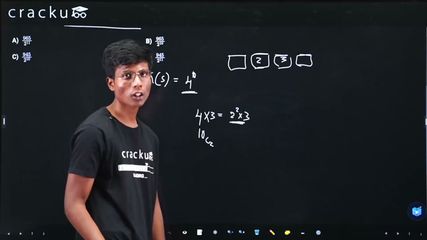
Click on the Email ☝️ to Watch the Video Solution
Create a FREE account and get:
_1.webp)

Educational materials for JEE preparation

Ask our AI anything

AI can make mistakes. Please verify important information.
AI can make mistakes. Please verify important information.
