
Join Our JEE Preparation Group
Prep with like-minded aspirants; Get access to free daily tests and study material.
Sign in
Please select an account to continue using cracku.in
↓ →
Join Our JEE Preparation Group
Prep with like-minded aspirants; Get access to free daily tests and study material.
If $$\frac{dy}{dx} = \frac{xy}{x^2+y^2}$$; $$y(1) = 1$$; then a value of $$x$$ satisfying $$y(x) = e$$ is:
We are given the differential equation $$\dfrac{dy}{dx}= \dfrac{xy}{x^{2}+y^{2}}$$ together with the initial condition $$y(1)=1$$. Our goal is to find the positive value of $$x$$ for which $$y(x)=e$$.
First, we observe that the right-hand side is a rational function in the ratio $$\dfrac{y}{x}$$, so the equation is homogeneous. For a homogeneous first-order differential equation we use the substitution $$y=vx$$, where $$v$$ is a function of $$x$$. (This is the standard method: if $$\dfrac{dy}{dx}=F\!\left(\dfrac{y}{x}\right)$$, we put $$y=vx$$ to obtain a separable equation in $$v$$ and $$x$$.)
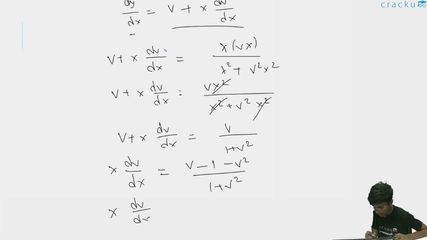
With $$y=vx$$, we have the derivative formula $$\dfrac{dy}{dx}=v+x\dfrac{dv}{dx}$$. Substituting $$y=vx$$ and $$\dfrac{dy}{dx}=v+x\dfrac{dv}{dx}$$ into the original differential equation gives
$$v+x\dfrac{dv}{dx}= \dfrac{x\,(vx)}{x^{2}+(vx)^{2}} =\dfrac{x^{2}v}{x^{2}\left(1+v^{2}\right)} =\dfrac{v}{1+v^{2}}.$$
We now isolate the term containing $$\dfrac{dv}{dx}$$:
$$x\dfrac{dv}{dx}= \dfrac{v}{1+v^{2}}-v = v\!\left(\dfrac{1}{1+v^{2}}-1\right) = v\!\left(\dfrac{1-(1+v^{2})}{1+v^{2}}\right) =-\dfrac{v^{3}}{1+v^{2}}.$$
Dividing both sides by $$x$$ and by the factor $$-\dfrac{v^{3}}{1+v^{2}}$$ (so that variables are separated) we obtain
$$\dfrac{1+v^{2}}{v^{3}}\,dv=-\dfrac{dx}{x}.$$
We split the integrand on the left:
$$\dfrac{1+v^{2}}{v^{3}} =\dfrac{1}{v^{3}}+\dfrac{v^{2}}{v^{3}} =v^{-3}+v^{-1}.$$
Hence the integral becomes
$$\int\!\left(v^{-3}+v^{-1}\right)\,dv =-\int\!\dfrac{dx}{x}.$$
We integrate term by term. Using the formulas $$\int v^{n}\,dv=\dfrac{v^{n+1}}{n+1}\quad(n\neq -1)$$ and $$\int\dfrac{dv}{v}=\ln|v|,$$ we get
$$\int v^{-3}\,dv = \dfrac{v^{-2}}{-2}=-\dfrac{1}{2v^{2}},\qquad \int v^{-1}\,dv = \ln|v|,$$
so that
$$-\dfrac{1}{2v^{2}}+\ln|v| = -\ln|x| + C,$$
where $$C$$ is the constant of integration.
We now impose the initial condition. At $$x=1$$ we have $$y=1$$, hence $$v=\dfrac{y}{x}=\dfrac{1}{1}=1.$$ Substituting $$x=1,\;v=1$$ in the last equation gives
$$-\dfrac{1}{2(1)^{2}}+\ln|1| = -\ln|1|+C \;\;\Longrightarrow\;\; -\dfrac{1}{2}+0 = 0 + C \;\;\Longrightarrow\;\; C=-\dfrac{1}{2}.$$
Therefore the implicit solution is
$$-\dfrac{1}{2v^{2}}+\ln|v| = -\ln|x|-\dfrac{1}{2}.$$
It is often convenient to multiply by $$-1$$ to write
$$\dfrac{1}{2v^{2}}-\ln|v| = \ln|x|+\dfrac{1}{2}.$$
We are interested in the point where $$y(x)=e$$. Let that unknown $$x$$ be denoted simply by $$x$$ (positive, because all given quantities are positive). Then
$$v=\dfrac{y}{x}=\dfrac{e}{x}.$$
Substituting $$v=\dfrac{e}{x}$$ into the relation $$-\dfrac{1}{2v^{2}}+\ln v = -\ln x-\dfrac{1}{2},$$ we proceed step by step.
We have $$-\dfrac{1}{2}\left(\dfrac{e}{x}\right)^{-2} =-\dfrac{1}{2}\cdot\dfrac{x^{2}}{e^{2}} =-\dfrac{x^{2}}{2e^{2}},$$ and $$\ln v=\ln\!\left(\dfrac{e}{x}\right) =\ln e-\ln x =1-\ln x.$$
Putting these into the equation gives
$$\left[-\dfrac{x^{2}}{2e^{2}}+1-\ln x\right] =-\ln x-\dfrac{1}{2}.$$
The logarithmic terms $$-\ln x$$ on both sides cancel, leaving
$$-\dfrac{x^{2}}{2e^{2}}+1=-\dfrac{1}{2}.$$
We shift the constant term to the right:
$$-\dfrac{x^{2}}{2e^{2}}=-\dfrac{1}{2}-1=-\dfrac{3}{2}.$$
Multiplying by $$-1$$ gives
$$\dfrac{x^{2}}{2e^{2}}=\dfrac{3}{2}.$$
Finally, multiplying both sides by $$2e^{2}$$ yields
$$x^{2}=3e^{2}.$$
Since we are dealing with positive quantities, we take the positive square root:
$$x=\sqrt{3}\,e.$$
This matches Option D in the given list. Hence, the correct answer is Option D.
Was this solution helpful?
Click on the Email ☝️ to Watch the Video Solution
Create a FREE account and get:
_1.webp)

Educational materials for JEE preparation

Ask our AI anything

AI can make mistakes. Please verify important information.
AI can make mistakes. Please verify important information.
