
Join Our JEE Preparation Group
Prep with like-minded aspirants; Get access to free daily tests and study material.
Sign in
Please select an account to continue using cracku.in
↓ →
Join Our JEE Preparation Group
Prep with like-minded aspirants; Get access to free daily tests and study material.
A random variable $$X$$ has the following probability distribution:
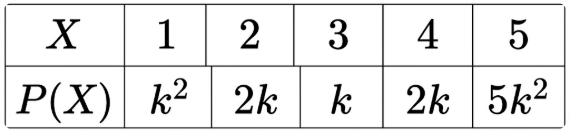
Then, $$P(X > 2)$$ is equal to:
For a discrete random variable the very first property we use is: “The sum of all the probabilities is equal to 1.” Stated mathematically, if the possible values of $$X$$ are $$x_1,x_2,\dots ,x_n$$ with respective probabilities $$p_1,p_2,\dots ,p_n,$$ then
$$\displaystyle \sum_{i=1}^{n} p_i \;=\;1.$$
Here the values and probabilities are given as
$$\begin{aligned} X &: \;1 \quad 2 \quad 3 \quad 4 \quad 5,\\[2mm] P(X) &: \;k^{2}\quad 2k \quad k \quad 2k \quad 5k^{2}. \end{aligned}$$
Applying the above property, we write
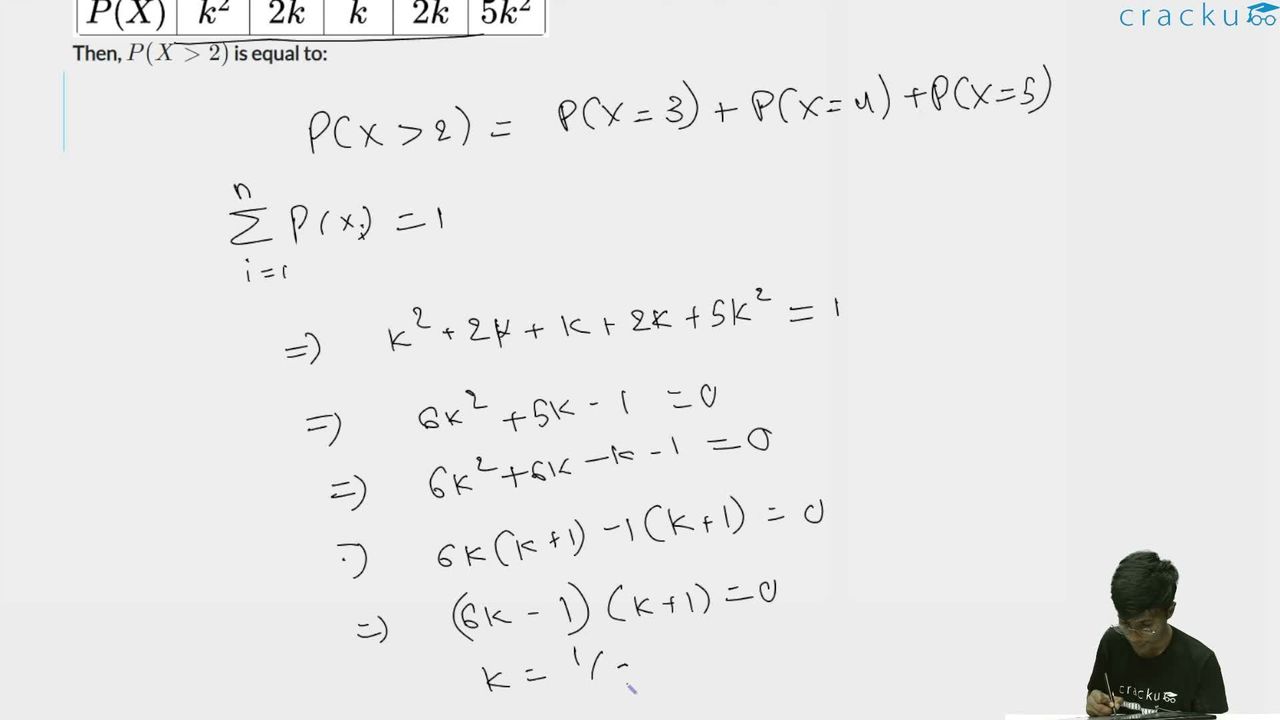
$$k^{2}+2k+k+2k+5k^{2}=1.$$
Now we collect like terms:
$$\bigl(k^{2}+5k^{2}\bigr)+\bigl(2k+k+2k\bigr)=1,$$
$$6k^{2}+5k=1.$$
Next we transpose the 1 to the left side so that every term lies on the same side of the equality:
$$6k^{2}+5k-1=0.$$
This is a quadratic equation in $$k$$ of the standard form $$ax^{2}+bx+c=0.$$ We now invoke the quadratic-formula, which states
$$x=\dfrac{-b\pm\sqrt{\,b^{2}-4ac\,}}{2a},\quad\text{for}\;ax^{2}+bx+c=0.$$
With $$a=6,\;b=5,\;c=-1$$ we substitute:
$$k=\frac{-5\pm\sqrt{\,5^{2}-4\cdot6\cdot(-1)\,}}{2\cdot6}.$$
Inside the square root we simplify step by step:
$$5^{2}=25,\quad -4\cdot6\cdot(-1)=24,$$
so
$$\sqrt{\,25+24\,}=\sqrt{49}=7.$$
Hence
$$k=\frac{-5\pm7}{12}.$$
This yields two numerical possibilities:
$$k=\frac{-5+7}{12}=\frac{2}{12}=\frac16,\qquad k=\frac{-5-7}{12}=\frac{-12}{12}=-1.$$
Because probability values must be non-negative, we discard the negative root. Therefore
$$k=\frac16.$$
We now proceed to the requested probability $$P(X>2).$$ The condition $$X>2$$ corresponds to the outcomes $$X=3,4,5.$$ Using the definition of probability for mutually exclusive events, we add their individual probabilities:
$$P(X>2)=P(X=3)+P(X=4)+P(X=5).$$
Substituting the expressions given in the table, we get
$$P(X>2)=k+2k+5k^{2}.$$
First we combine like terms:
$$k+2k=3k,$$
so
$$P(X>2)=3k+5k^{2}.$$
Now we replace $$k$$ by the value already obtained, $$k=\dfrac16$$:
$$P(X>2)=3\left(\frac16\right)+5\left(\frac16\right)^{2}.$$
We simplify each term separately. For the linear term,
$$3\left(\frac16\right)=\frac36=\frac12.$$
For the quadratic term, first square the denominator: $$\left(\frac16\right)^{2}=\frac1{36}.$$ Then multiply by 5:
$$5\left(\frac1{36}\right)=\frac5{36}.$$
Adding the two fractions with a common denominator of 36, we have
$$\frac12+\frac5{36}=\frac{18}{36}+\frac5{36}=\frac{23}{36}.$$
Thus
$$P(X>2)=\frac{23}{36}.$$
Consulting the options given, the fraction $$\dfrac{23}{36}$$ corresponds to Option D.
Hence, the correct answer is Option D.
Was this solution helpful?
Click on the Email ☝️ to Watch the Video Solution
Create a FREE account and get:
_1.webp)

Educational materials for JEE preparation

Ask our AI anything

AI can make mistakes. Please verify important information.
AI can make mistakes. Please verify important information.
