
Join Our JEE Preparation Group
Prep with like-minded aspirants; Get access to free daily tests and study material.
Sign in
Please select an account to continue using cracku.in
↓ →
Join Our JEE Preparation Group
Prep with like-minded aspirants; Get access to free daily tests and study material.
Arrange the following solutions in order of their increasing boiling points. (i) $$10^{-4} M$$ $$NaCl$$ (ii) $$10^{-4}M$$ $$Urea$$ (iii) $$10^{-3} M$$ $$NaCl$$ (iv) $$10^{-2} M$$ $$NaCl$$
Arrange the solutions in order of increasing boiling points.
We recall that boiling point elevation depends on the total solute particle concentration.
$$\Delta T_b = i \cdot K_b \cdot m$$
Here, $$i$$ is the van't Hoff factor.
Next, we calculate the effective concentration for each solution.
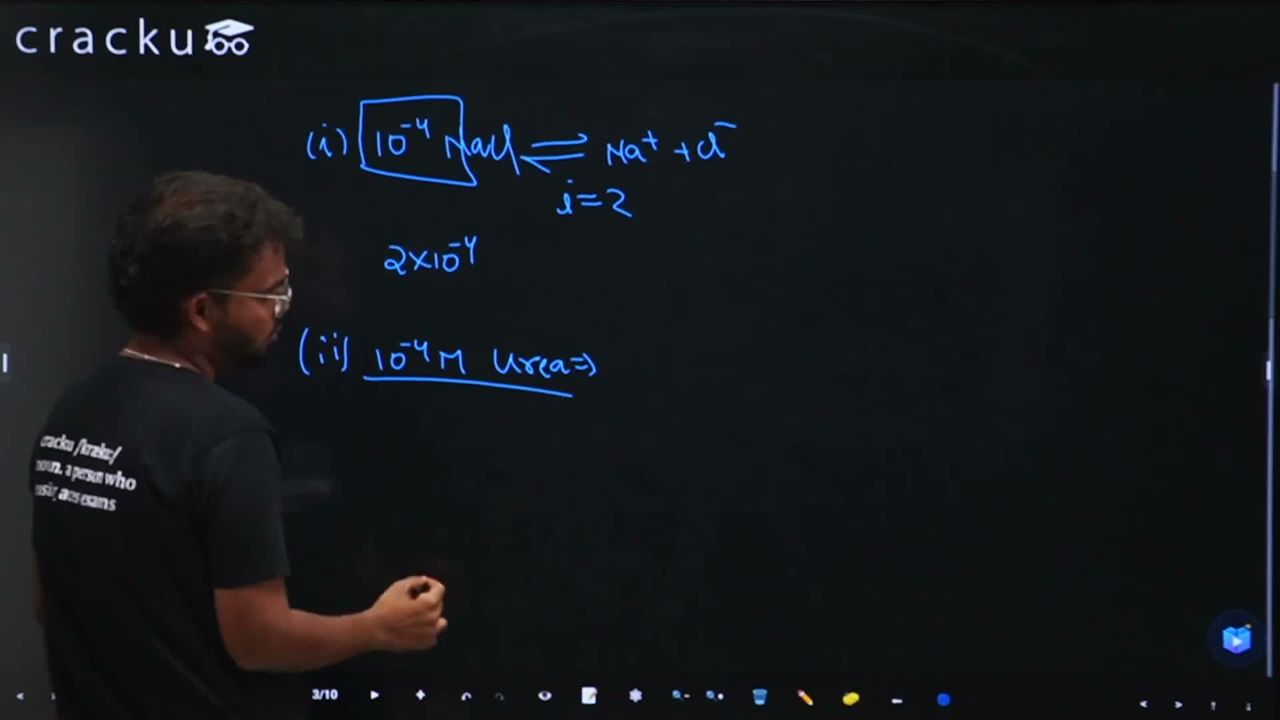
For (i) $$10^{-4}$$ M NaCl, which dissociates as NaCl → Na⁺ + Cl⁻, the van't Hoff factor is $$i = 2$$ giving an effective concentration of $$2 \times 10^{-4}$$ M.
For (ii) $$10^{-4}$$ M urea, a non-electrolyte with $$i = 1$$, the effective concentration is $$10^{-4}$$ M.
For (iii) $$10^{-3}$$ M NaCl with $$i = 2$$, the effective concentration becomes $$2 \times 10^{-3}$$ M.
For (iv) $$10^{-2}$$ M NaCl with $$i = 2$$, the effective concentration becomes $$2 \times 10^{-2}$$ M.
Ordering these effective concentrations yields
$$10^{-4} < 2 \times 10^{-4} < 2 \times 10^{-3} < 2 \times 10^{-2}$$
Hence, in terms of the given options:
$$(\text{ii}) < (\text{i}) < (\text{iii}) < (\text{iv})$$
Therefore, the solutions in order of increasing boiling point are (ii) < (i) < (iii) < (iv).
Was this solution helpful?
Click on the Email ☝️ to Watch the Video Solution
Create a FREE account and get:
_1.webp)

Educational materials for JEE preparation

Ask our AI anything

AI can make mistakes. Please verify important information.
AI can make mistakes. Please verify important information.
