
Join Our JEE Preparation Group
Prep with like-minded aspirants; Get access to free daily tests and study material.
Sign in
Please select an account to continue using cracku.in
↓ →
Join Our JEE Preparation Group
Prep with like-minded aspirants; Get access to free daily tests and study material.
In which of the following complexes the CFSE, $$\triangle_o$$ will be equal to zero?
We need to find the complex where CFSE ($$\Delta_o$$) is zero.
Key concept: CFSE is zero when the d-orbitals are either empty (d⁰), half-filled (d⁵ in weak field), or completely filled (d¹⁰), because the stabilization from electrons in $$t_{2g}$$ is exactly cancelled by destabilization from electrons in $$e_g$$.
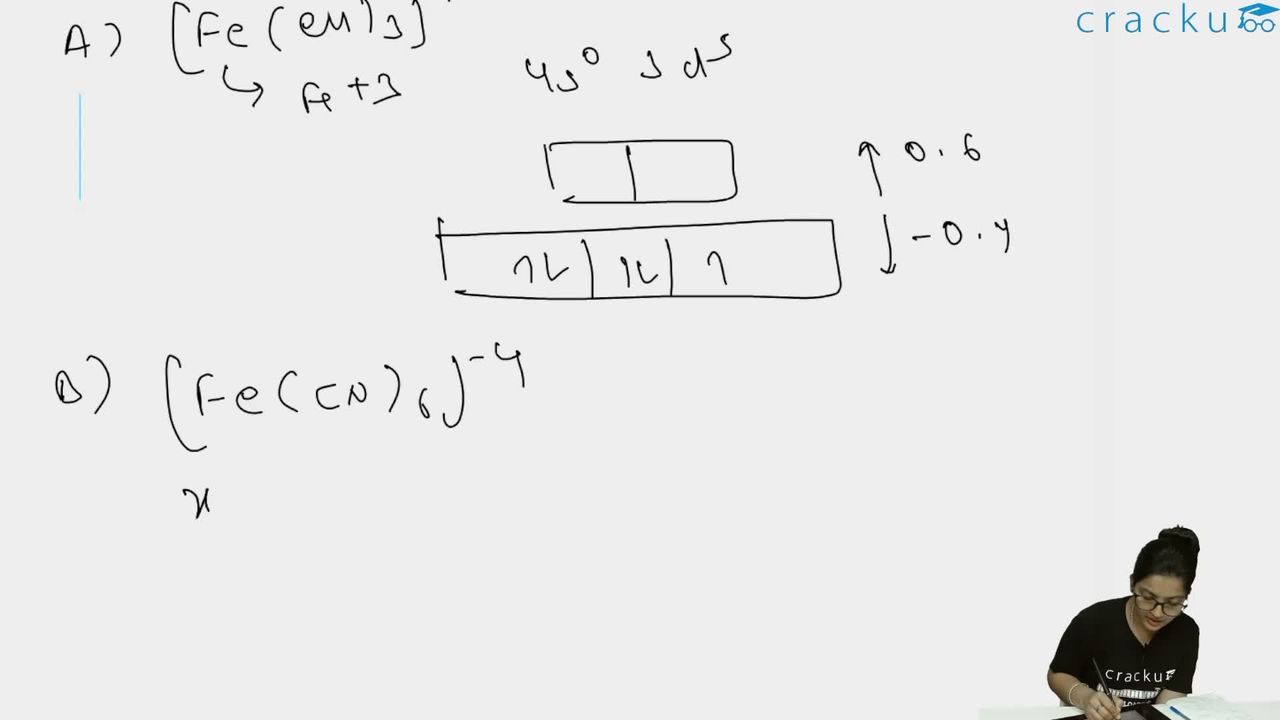
Specifically for an octahedral weak field complex: d⁵ configuration gives CFSE = $$(-0.4 \times 3 + 0.6 \times 2)\Delta_o = 0$$.
Analyze each option:
(A) $$[Fe(en)_3]Cl_3$$: Fe³⁺ is d⁵. en is a strong field ligand, so this is a low-spin complex with CFSE = $$-2.0\Delta_o$$. CFSE is NOT zero.
(B) $$K_4[Fe(CN)_6]$$: Fe²⁺ is d⁶. CN⁻ is a strong field ligand (low spin), CFSE = $$-2.4\Delta_o$$. NOT zero.
(C) $$[Fe(NH_3)_6]Br_2$$: Fe²⁺ is d⁶. NH₃ is a moderate-strong field ligand. CFSE is NOT zero.
(D) $$K_3[Fe(SCN)_6]$$: Fe³⁺ is d⁵. SCN⁻ is a weak field ligand, so this is a high-spin complex. For high-spin d⁵: electrons are distributed as $$t_{2g}^3 e_g^2$$.
CFSE = $$3(-0.4\Delta_o) + 2(0.6\Delta_o) = -1.2\Delta_o + 1.2\Delta_o = 0$$
The correct answer is Option 4: $$K_3[Fe(SCN)_6]$$.
Was this solution helpful?
Click on the Email ☝️ to Watch the Video Solution
Create a FREE account and get:
Educational materials for JEE preparation

Ask our AI anything

AI can make mistakes. Please verify important information.
AI can make mistakes. Please verify important information.

_1.webp)
