
Join Our JEE Preparation Group
Prep with like-minded aspirants; Get access to free daily tests and study material.
Sign in
Please select an account to continue using cracku.in
↓ →
Join Our JEE Preparation Group
Prep with like-minded aspirants; Get access to free daily tests and study material.
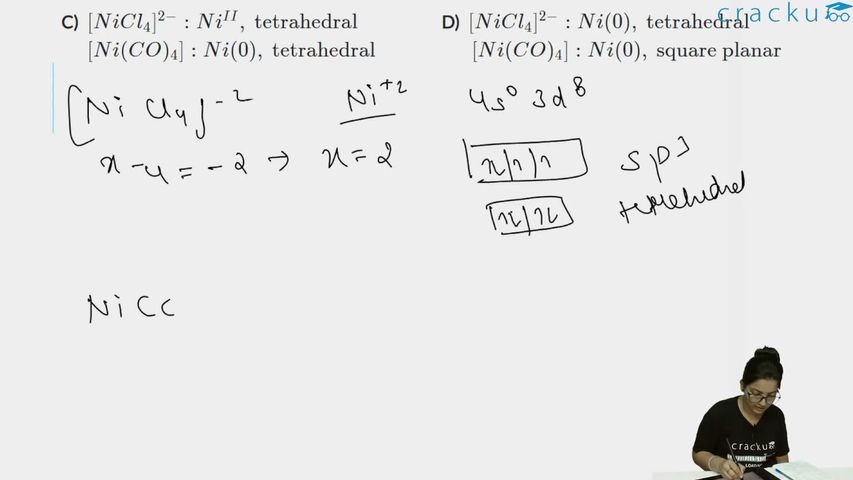
From the magnetic behaviour of $$[NiCl_4]^{2-} \text{(paramagnetic) and } [Ni(CO)_4] $$ (diamagnetic), choose the correct geometry and oxidation state.
We need to determine the geometry and oxidation state of Ni in $$[NiCl_4]^{2-}$$ (paramagnetic) and $$[Ni(CO)_4]$$ (diamagnetic).
We first analyze $$[NiCl_4]^{2-}$$. Charge balance Ni + 4(−1) = −2 indicates Ni is in the +2 oxidation state and thus has a d⁸ configuration. As Cl⁻ is a weak field ligand with four coordination sites, the complex adopts a tetrahedral geometry. A tetrahedral d⁸ complex has two unpaired electrons, explaining the paramagnetism.
Next, we analyze $$[Ni(CO)_4]$$. CO is a neutral ligand and Ni + 4(0) = 0 shows Ni is in the 0 oxidation state, corresponding to d¹⁰. With all d‐orbitals filled and four coordination sites, the complex remains tetrahedral rather than square planar. The d¹⁰ configuration has no unpaired electrons, which accounts for the observed diamagnetism.
In summary, $$[NiCl_4]^{2-}$$ features Ni(II) in a tetrahedral geometry with two unpaired electrons, while $$[Ni(CO)_4]$$ contains Ni(0) in a tetrahedral geometry with all electrons paired. The correct answer is Option 3.
Was this solution helpful?
Click on the Email ☝️ to Watch the Video Solution
Create a FREE account and get:
Educational materials for JEE preparation

Ask our AI anything

AI can make mistakes. Please verify important information.
AI can make mistakes. Please verify important information.

_1.webp)
