
Join Our JEE Preparation Group
Prep with like-minded aspirants; Get access to free daily tests and study material.
Sign in
Please select an account to continue using cracku.in
↓ →
Join Our JEE Preparation Group
Prep with like-minded aspirants; Get access to free daily tests and study material.
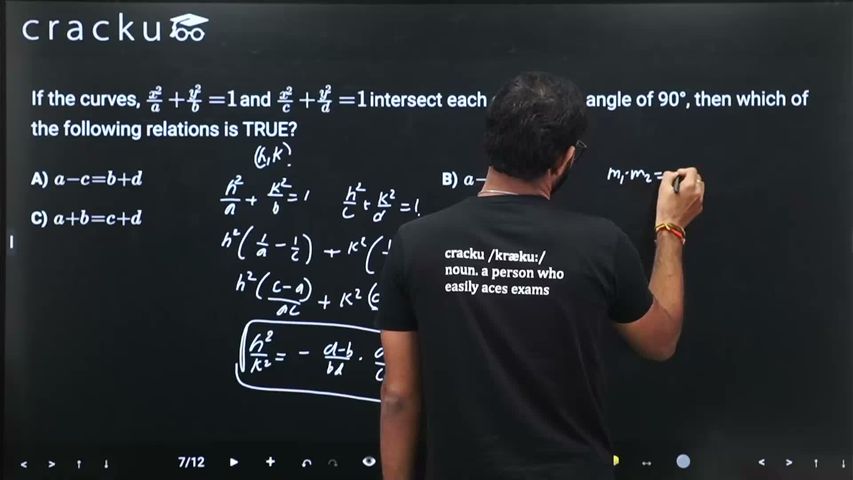
If the curves, $$\frac{x^2}{a} + \frac{y^2}{b} = 1$$ and $$\frac{x^2}{c} + \frac{y^2}{d} = 1$$ intersect each other at an angle of 90°, then which of the following relations is TRUE?
Given curves
$$\frac{x^2}{a}+\frac{y^2}{b}=1 \quad\cdots(1)$$ and $$\frac{x^2}{c}+\frac{y^2}{d}=1 \quad\cdots(2)$$ intersect orthogonally.
We need to find the correct relation among $$a,b,c,d.$$
Differentiate (1):
$$\frac{2x}{a}+\frac{2y}{b}\frac{dy}{dx}=0$$
$$\frac{dy}{dx}=-\frac{bx}{ay}$$
Hence slope of tangent to (1) is $$m_1=-\frac{bx}{ay}$$
Now differentiate (2): $$\frac{2x}{c}+\frac{2y}{d}\frac{dy}{dx}=0$$
$$\frac{dy}{dx} =-\frac{dx}{cy}$$
Hence slope of tangent to (2) is $$m_2=-\frac{dx}{cy}$$
Since the curves intersect at $$90^\circ,$$ their tangents are perpendicular.
Therefore,
$$m_1m_2=-1$$
Substituting,
$$\left(-\frac{bx}{ay}\right) \left(-\frac{dx}{cy}\right)=-1$$
$$\frac{bdx^2}{acy^2}=-1 \quad\cdots(3)$$
Now from equations (1) and (2),
$$\frac{x^2}{a}+\frac{y^2}{b}=1$$
$$\frac{x^2}{c}+\frac{y^2}{d}=1$$
Subtracting,
$$x^2\left(\frac1a-\frac1c\right)+y^2\left(\frac1b-\frac1d\right)=0$$
$$x^2\frac{c-a}{ac} +y^2\frac{d-b}{bd}=0$$
$$bd(c-a)x^2 +ac(d-b)y^2=0$$
$$bd(a-c)x^2 =ac(d-b)y^2 \quad\cdots(4)$$
Using (3),
$$\frac{x^2}{y^2} =\frac{-ac}{bd}$$
Substitute into (4):
$$bd(a-c)\left(\frac{-ac}{bd}\right) =ac(d-b)$$
$$-(a-c)=d-b$$
$$a-c=b-d$$
Hence,
$$a-b=c-d$$
Therefore, the correct option is
$$\boxed{a-b=c-d}$$
Was this solution helpful?
Click on the Email ☝️ to Watch the Video Solution
Create a FREE account and get:
_1.webp)

Educational materials for JEE preparation

Ask our AI anything

AI can make mistakes. Please verify important information.
AI can make mistakes. Please verify important information.
