
Join Our JEE Preparation Group
Prep with like-minded aspirants; Get access to free daily tests and study material.
Sign in
Please select an account to continue using cracku.in
↓ →
Join Our JEE Preparation Group
Prep with like-minded aspirants; Get access to free daily tests and study material.
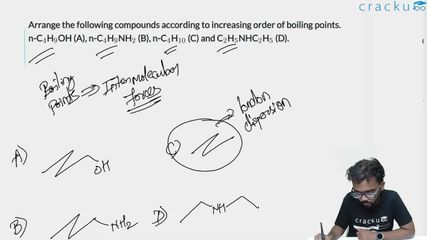
Arrange the following compounds according to increasing order of boiling points.
n-C$$_4$$H$$_9$$OH (A), n-C$$_4$$H$$_9$$NH$$_2$$ (B), n-C$$_4$$H$$_{10}$$ (C) and C$$_2$$H$$_5$$NHC$$_2$$H$$_5$$ (D).
The boiling point of a compound depends primarily on the strength of its intermolecular forces. Stronger intermolecular attractions require more energy to overcome, resulting in a higher boiling point.
(n)-Butane ((C)) is a non-polar hydrocarbon and exhibits only London dispersion forces. Therefore, it has the lowest boiling point among the given compounds.
Diethylamine ((D)) is a secondary amine and possesses an (N-H) bond, allowing intermolecular hydrogen bonding. However, the extent of hydrogen bonding is less than that in a primary amine.
(n)-Butylamine ((B)) is a primary amine and forms stronger and more extensive intermolecular hydrogen bonding than diethylamine, giving it a higher boiling point.
(n)-Butanol ((A)) contains an (O-H) bond, and oxygen is more electronegative than nitrogen. Consequently, alcohols exhibit stronger hydrogen bonding than amines, making butanol the highest boiling compound in the given set.
Therefore, the increasing order of boiling points is
$$C<D<B<A.$$
Hence, the correct answer is C < D < B < A.
Was this solution helpful?
Click on the Email ☝️ to Watch the Video Solution
Create a FREE account and get:
_1.webp)

Educational materials for JEE preparation

Ask our AI anything

AI can make mistakes. Please verify important information.
AI can make mistakes. Please verify important information.


