
Join Our JEE Preparation Group
Prep with like-minded aspirants; Get access to free daily tests and study material.
Sign in
Please select an account to continue using cracku.in
↓ →
Join Our JEE Preparation Group
Prep with like-minded aspirants; Get access to free daily tests and study material.
Predict the major product of the following reaction sequence:
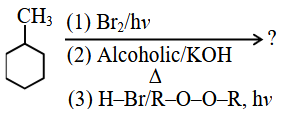
To determine the major product of the given reaction sequence, we analyze the transformation occurring in each step.
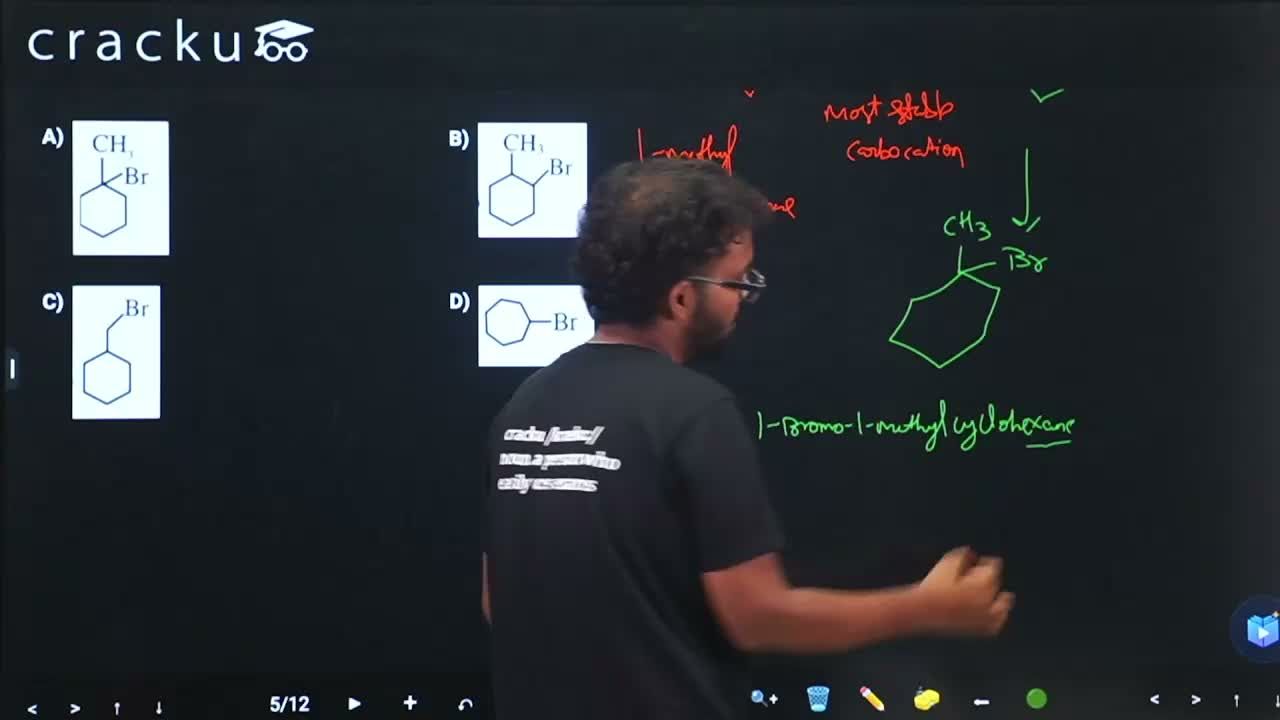
The starting compound is methylcyclohexane. In the presence of $$Br_2/h\nu$$, bromination proceeds through a free radical substitution mechanism. Bromination is highly selective and preferentially abstracts the hydrogen atom whose removal generates the most stable carbon radical. In methylcyclohexane, abstraction of the tertiary hydrogen attached to the carbon bearing the methyl group produces the most stable radical intermediate. Consequently, the major product formed is 1-bromo-1-methylcyclohexane.
The brominated intermediate is then treated with alcoholic $$KOH$$ under heating. Alcoholic potassium hydroxide acts as a strong base and promotes an E2 elimination reaction. According to Zaitsev's rule, elimination preferentially forms the more substituted and more stable alkene. Removal of a $$\beta$$-hydrogen from the adjacent ring carbon generates the trisubstituted alkene 1-methylcyclohex-1-ene, which is favored over the less substituted alternative.
Finally, the alkene is treated with $$HBr$$ in the presence of peroxides $$\left(R-O-O-R\right)$$ and light. Under these conditions, the reaction proceeds through the free radical (peroxide) mechanism, giving anti-Markovnikov addition of $$HBr$$. The bromine radical adds to the less substituted carbon of the double bond so that the intermediate radical formed is the more stable tertiary radical. Subsequent abstraction of hydrogen from $$HBr$$ completes the reaction.
Thus, bromine attaches to the carbon adjacent to the methyl-substituted carbon, while hydrogen adds to the carbon already bearing the methyl group, producing 1-bromo-2-methylcyclohexane.
The overall transformation can be summarized as
$$\text{Methylcyclohexane} \xrightarrow{Br_2/h\nu} \text{1-bromo-1-methylcyclohexane} \xrightarrow{\text{alc. }KOH,\ \Delta} \text{1-methylcyclohex-1-ene} \xrightarrow{HBr,\ R-O-O-R,\ h\nu} \text{1-bromo-2-methylcyclohexane}.$$
Hence, the major product is 1-bromo-2-methylcyclohexane, corresponding to Option B.
Was this solution helpful?
Click on the Email ☝️ to Watch the Video Solution
Create a FREE account and get:
Educational materials for JEE preparation

Ask our AI anything

AI can make mistakes. Please verify important information.
AI can make mistakes. Please verify important information.

_1.webp)
