
Join Our JEE Preparation Group
Prep with like-minded aspirants; Get access to free daily tests and study material.
Sign in
Please select an account to continue using cracku.in
↓ →
Join Our JEE Preparation Group
Prep with like-minded aspirants; Get access to free daily tests and study material.
Match List - I with List - II.
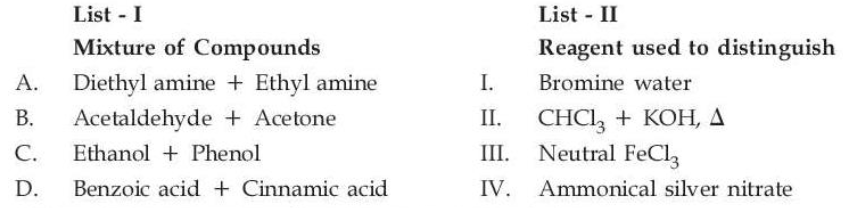
Choose the correct answer from the options given below :
Case A: Mixture: Diethyl amine (a secondary amine) + Ethyl amine (a primary amine)
Reagents available: one of them must differentiate primary vs. secondary amines.
The carbylamine (isocyanide) test uses hot $$CHCl_3$$ and alcoholic $$KOH$$. A primary amine gives an extremely foul-smelling isocyanide; secondary and tertiary amines do not react.
Therefore only Ethyl amine responds, not Diethyl amine.
Thus the mixture is distinguished by reagent II.
Case B: Mixture: Acetaldehyde (aldehyde) + Acetone (ketone)
Tollen’s reagent (ammoniacal $$AgNO_3$$) oxidises aldehydes to carboxylate ions while reducing $$Ag^+$$ to metallic silver (silver mirror). Ketones do not react under these mild conditions.
Hence acetaldehyde gives a silver mirror; acetone remains unchanged.
Reagent IV is the correct choice.
Case C: Mixture: Ethanol (simple alcohol) + Phenol (aromatic alcohol with acidic -OH)
Neutral $$FeCl_3$$ reacts with phenols to form coloured (violet, blue, green) complexes, whereas ordinary alcohols such as ethanol show no colour change.
Thus reagent III distinguishes the two.
Case D: Mixture: Benzoic acid (no C=C) + Cinnamic acid (contains a C=C conjugated with the benzene ring)
Aqueous bromine (bromine water) is decolourised by compounds that add Br₂ across a carbon-carbon double bond. Cinnamic acid possesses such a double bond and rapidly decolourises bromine water; benzoic acid does not.
Therefore reagent I is the correct discriminator.
Collecting all matches:
A → II B → IV C → III D → I
Option D which is: A-II, B-IV, C-III, D-I
Was this solution helpful?
Click on the Email ☝️ to Watch the Video Solution
Create a FREE account and get:
_1.webp)

Educational materials for JEE preparation

Ask our AI anything

AI can make mistakes. Please verify important information.
AI can make mistakes. Please verify important information.
