
Join Our JEE Preparation Group
Prep with like-minded aspirants; Get access to free daily tests and study material.
Sign in
Please select an account to continue using cracku.in
↓ →
Join Our JEE Preparation Group
Prep with like-minded aspirants; Get access to free daily tests and study material.
Consider the three aromatic molecules (P, Q and R) whose structures have been given below :
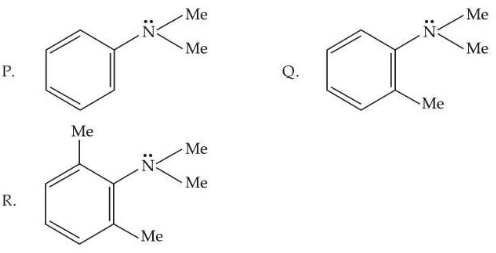
The correct order regarding the reactivity of these compounds with
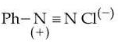
under optimum but slightly acidic medium is :
The reaction described is an azo-coupling reaction (electrophilic aromatic substitution) with a benzenediazonium ion. For this reaction to occur efficiently, the benzene ring must be highly activated with high electron density, primarily provided by the strong mesomeric ($$+M$$) donating effect of the nitrogen's lone pair.
As the number of ortho-methyl groups increases, resonance decreases, dropping the electron density on the ring and reducing its reactivity toward electrophiles:
$$\text{P} > \text{Q} > \text{R}$$
Therefore, the correct choice is [A] P > Q > R.
Was this solution helpful?

Click on the Email ☝️ to Watch the Video Solution
Create a FREE account and get:
_1.webp)

Educational materials for JEE preparation

Ask our AI anything

AI can make mistakes. Please verify important information.
AI can make mistakes. Please verify important information.
