
Join Our JEE Preparation Group
Prep with like-minded aspirants; Get access to free daily tests and study material.
Sign in
Please select an account to continue using cracku.in
↓ →
Join Our JEE Preparation Group
Prep with like-minded aspirants; Get access to free daily tests and study material.
Consider the following reaction.
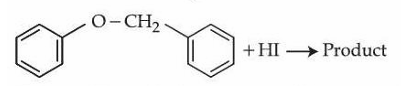
Statement I : In the above reaction, product formed will be a mixture of benzyl alcohol and iodobenzene.
Statement II : In the above reaction, the $$-O-CH_2-$$ bond is cleaved to give the product.
In the light of the above statements, choose the correct answer from the options given below :
The ether undergoes cleavage in the presence of HI. Benzyl phenyl ether contains two different C-O bonds:
The first step is protonation of the ether oxygen by HI, forming an oxonium ion.
The iodide ion then attacks the carbon atom attached to oxygen. The $$\mathrm{Ph-O}$$ bond is resistant to cleavage because it possesses partial double bond character due to resonance, and nucleophilic substitution at an $$sp^2$$ hybridized aromatic carbon is not feasible.
Therefore, the iodide ion attacks the benzyl carbon through an $$S_N2$$ mechanism, resulting in cleavage of the $$\mathrm{-O-CH_2-}$$ bond.
The products formed are:
$$\mathrm{Ph-OH\ +\ PhCH_2I}$$
Statement I: "The products formed are benzyl alcohol and iodobenzene."
This statement is incorrect because the actual products are phenol and benzyl iodide.
Hence, Statement I is false.
Statement II: "The $$\mathrm{-O-CH_2-}$$ bond is cleaved to give the product."
This statement is correct because cleavage occurs at the benzyl carbon.
Hence, Statement II is true.
Therefore, Statement I is false, but Statement II is true. Hence, the correct option is (D).
Was this solution helpful?
Create a FREE account and get:
_1.webp)

Educational materials for JEE preparation

Ask our AI anything

AI can make mistakes. Please verify important information.
AI can make mistakes. Please verify important information.
