
Join Our JEE Preparation Group
Prep with like-minded aspirants; Get access to free daily tests and study material.
Sign in
Please select an account to continue using cracku.in
↓ →
Join Our JEE Preparation Group
Prep with like-minded aspirants; Get access to free daily tests and study material.
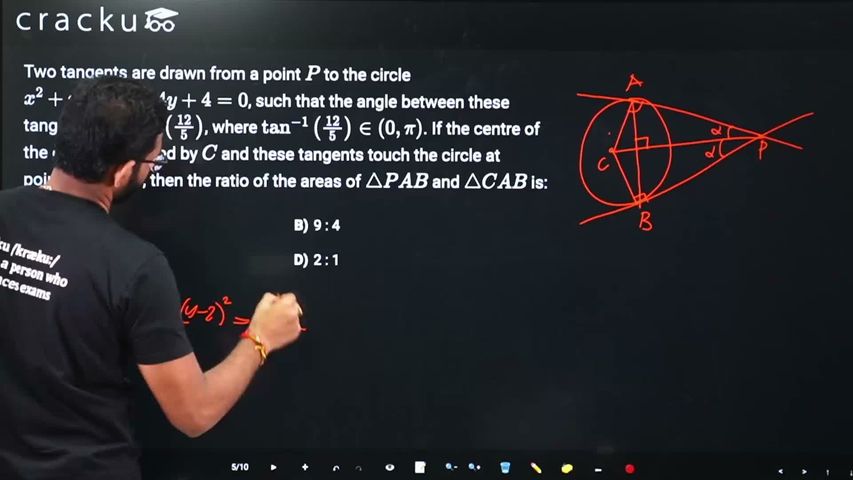
Two tangents are drawn from a point $$P$$ to the circle $$x^2 + y^2 - 2x - 4y + 4 = 0$$, such that the angle between these tangents is $$\tan^{-1}\left(\frac{12}{5}\right)$$, where $$\tan^{-1}\left(\frac{12}{5}\right) \in (0, \pi)$$. If the centre of the circle is denoted by $$C$$ and these tangents touch the circle at points $$A$$ and $$B$$, then the ratio of the areas of $$\triangle PAB$$ and $$\triangle CAB$$ is:
The circle is $$x^2 + y^2 - 2x - 4y + 4 = 0$$. Completing the square: $$(x-1)^2 + (y-2)^2 = 1 + 4 - 4 = 1$$. So the centre is $$C = (1, 2)$$ and radius $$r = 1$$.
Two tangents are drawn from an external point $$P$$ to this circle, touching it at points $$A$$ and $$B$$. The angle between the two tangents is $$2\alpha = \tan^{-1}\left(\frac{12}{5}\right)$$. Here $$\alpha$$ denotes the half-angle (the angle each tangent makes with the line $$PC$$).
From the given information, $$\tan(2\alpha) = \frac{12}{5}$$. Using the double-angle formula $$\tan(2\alpha) = \frac{2\tan\alpha}{1 - \tan^2\alpha}$$, we set up the equation: $$\frac{2\tan\alpha}{1 - \tan^2\alpha} = \frac{12}{5}$$.
Cross-multiplying: $$10\tan\alpha = 12(1 - \tan^2\alpha) = 12 - 12\tan^2\alpha$$. Rearranging: $$12\tan^2\alpha + 10\tan\alpha - 12 = 0$$, or equivalently $$6\tan^2\alpha + 5\tan\alpha - 6 = 0$$.
Factoring this quadratic: $$(3\tan\alpha - 2)(2\tan\alpha + 3) = 0$$. This gives $$\tan\alpha = \frac{2}{3}$$ or $$\tan\alpha = -\frac{3}{2}$$. Since $$\alpha \in \left(0, \frac{\pi}{2}\right)$$, we need $$\tan\alpha > 0$$, so $$\tan\alpha = \frac{2}{3}$$.
From $$\tan\alpha = \frac{2}{3}$$, we get $$\sin\alpha = \frac{2}{\sqrt{13}}$$ and $$\cos\alpha = \frac{3}{\sqrt{13}}$$ (using a right triangle with opposite = 2, adjacent = 3, hypotenuse = $$\sqrt{13}$$).
In the right triangle $$\triangle PCA$$ (where the tangent $$PA$$ meets the radius $$CA$$ at a right angle), we have $$\sin\alpha = \frac{CA}{PC} = \frac{r}{PC} = \frac{1}{PC}$$. So $$PC = \frac{1}{\sin\alpha} = \frac{\sqrt{13}}{2}$$.
The tangent length from $$P$$ is $$PA = PB = \sqrt{PC^2 - r^2} = \sqrt{\frac{13}{4} - 1} = \sqrt{\frac{9}{4}} = \frac{3}{2}$$.
Both triangles $$\triangle PAB$$ and $$\triangle CAB$$ share the base $$AB$$. The line $$PC$$ is the axis of symmetry, and it passes through the midpoint $$M$$ of chord $$AB$$, with $$PM \perp AB$$ and $$CM \perp AB$$.
The height from $$P$$ to $$AB$$ is $$PM = PA \cos\alpha = \frac{3}{2} \cdot \frac{3}{\sqrt{13}} = \frac{9}{2\sqrt{13}}$$.
The height from $$C$$ to $$AB$$ is $$CM = CA \cos(\angle ACM)$$. Since $$\angle ACM = \frac{\pi}{2} - \alpha$$ (from the right angle at $$A$$), $$CM = r\cos\left(\frac{\pi}{2} - \alpha\right) = r\sin\alpha = 1 \cdot \frac{2}{\sqrt{13}} = \frac{2}{\sqrt{13}}$$. Alternatively, $$CM = PC - PM = \frac{\sqrt{13}}{2} - \frac{9}{2\sqrt{13}} = \frac{13 - 9}{2\sqrt{13}} = \frac{4}{2\sqrt{13}} = \frac{2}{\sqrt{13}}$$.
The ratio of areas is: $$\frac{\text{Area}(\triangle PAB)}{\text{Area}(\triangle CAB)} = \frac{\frac{1}{2} \cdot AB \cdot PM}{\frac{1}{2} \cdot AB \cdot CM} = \frac{PM}{CM} = \frac{9/(2\sqrt{13})}{2/\sqrt{13}} = \frac{9}{2\sqrt{13}} \times \frac{\sqrt{13}}{2} = \frac{9}{4}$$.
The ratio of areas is $$9 : 4$$, which is Option B.
Was this solution helpful?
Click on the Email ☝️ to Watch the Video Solution
Create a FREE account and get:
_1.webp)

Educational materials for JEE preparation

Ask our AI anything

AI can make mistakes. Please verify important information.
AI can make mistakes. Please verify important information.


