
Join Our JEE Preparation Group
Prep with like-minded aspirants; Get access to free daily tests and study material.
Sign in
Please select an account to continue using cracku.in
↓ →
Join Our JEE Preparation Group
Prep with like-minded aspirants; Get access to free daily tests and study material.
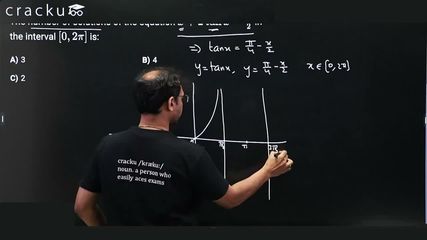
The number of solutions of the equation $$x + 2\tan x = \frac{\pi}{2}$$ in the interval $$[0, 2\pi]$$ is:
We need to find the number of solutions of $$x + 2\tan x = \frac{\pi}{2}$$ in $$[0, 2\pi]$$.
Rearranging, we get $$2\tan x = \frac{\pi}{2} - x$$, which gives $$\tan x = \frac{1}{2}\left(\frac{\pi}{2} - x\right)$$.
Let us define $$f(x) = \tan x$$ and $$g(x) = \frac{1}{2}\left(\frac{\pi}{2} - x\right)$$. The solutions are the intersection points of these two curves in $$[0, 2\pi]$$.
The function $$g(x)$$ is a straight line with slope $$-\frac{1}{2}$$ and $$y$$-intercept $$\frac{\pi}{4}$$. At $$x = 0$$, $$g(0) = \frac{\pi}{4} \approx 0.785$$. At $$x = \frac{\pi}{2}$$, $$g\left(\frac{\pi}{2}\right) = 0$$. At $$x = \pi$$, $$g(\pi) = -\frac{\pi}{4}$$. At $$x = 2\pi$$, $$g(2\pi) = -\frac{3\pi}{4}$$.
The function $$\tan x$$ has vertical asymptotes at $$x = \frac{\pi}{2}$$ and $$x = \frac{3\pi}{2}$$, and is continuous on the intervals $$\left[0, \frac{\pi}{2}\right)$$, $$\left(\frac{\pi}{2}, \frac{3\pi}{2}\right)$$, and $$\left(\frac{3\pi}{2}, 2\pi\right]$$.
In the interval $$\left[0, \frac{\pi}{2}\right)$$: $$\tan x$$ increases from $$0$$ to $$+\infty$$, while $$g(x)$$ decreases from $$\frac{\pi}{4}$$ to $$0$$. At $$x = 0$$, $$\tan 0 = 0 < \frac{\pi}{4} = g(0)$$. As $$x \to \frac{\pi}{2}^-$$, $$\tan x \to +\infty$$ while $$g(x) \to 0$$. So $$\tan x$$ crosses $$g(x)$$ exactly once in this interval.
In the interval $$\left(\frac{\pi}{2}, \frac{3\pi}{2}\right)$$: $$\tan x$$ goes from $$-\infty$$ to $$+\infty$$. The line $$g(x)$$ is continuous on this interval, taking finite values. Since $$\tan x$$ is continuous and strictly increasing on this interval, going from $$-\infty$$ to $$+\infty$$, it crosses the line $$g(x)$$ exactly once.
In the interval $$\left(\frac{3\pi}{2}, 2\pi\right]$$: $$\tan x$$ goes from $$-\infty$$ to $$0$$. At $$x = \frac{3\pi}{2}$$, $$g\left(\frac{3\pi}{2}\right) = \frac{1}{2}\left(\frac{\pi}{2} - \frac{3\pi}{2}\right) = -\frac{\pi}{2} \approx -1.57$$. At $$x = 2\pi$$, $$g(2\pi) = -\frac{3\pi}{4} \approx -2.36$$ and $$\tan(2\pi) = 0$$. Since $$\tan x$$ comes from $$-\infty$$ and increases to $$0$$, while $$g(x)$$ takes finite negative values (between $$-\frac{\pi}{2}$$ and $$-\frac{3\pi}{4}$$), the curves cross exactly once.
Therefore, the total number of solutions is $$3$$, which is Option A.
Was this solution helpful?
Click on the Email ☝️ to Watch the Video Solution
Create a FREE account and get:
_1.webp)

Educational materials for JEE preparation

Ask our AI anything

AI can make mistakes. Please verify important information.
AI can make mistakes. Please verify important information.


