
Join Our JEE Preparation Group
Prep with like-minded aspirants; Get access to free daily tests and study material.
Sign in
Please select an account to continue using cracku.in
↓ →
Join Our JEE Preparation Group
Prep with like-minded aspirants; Get access to free daily tests and study material.
The sum of solutions of the equation $$\frac{\cos x}{1+\sin x} = |\tan 2x|$$, $$x \in \left(-\frac{\pi}{2}, \frac{\pi}{2}\right) - \left\{-\frac{\pi}{4}, \frac{\pi}{4}\right\}$$ is:
Step 1: Simplify the Left Hand Side
The given equation is:
$$\frac{\cos x}{1 + \sin x} = |\tan 2x|$$
Transform the numerator and the denominator using complementary angles to convert them into sine and cosine functions that can be easily halved:
$$\cos x = \sin\left(\frac{\pi}{2} - x\right)$$
$$1 + \sin x = 1 + \cos\left(\frac{\pi}{2} - x\right)$$
Substitute these into the Left Hand Side fraction:
$$\text{LHS} = \frac{\sin\left(\frac{\pi}{2} - x\right)}{1 + \cos\left(\frac{\pi}{2} - x\right)}$$
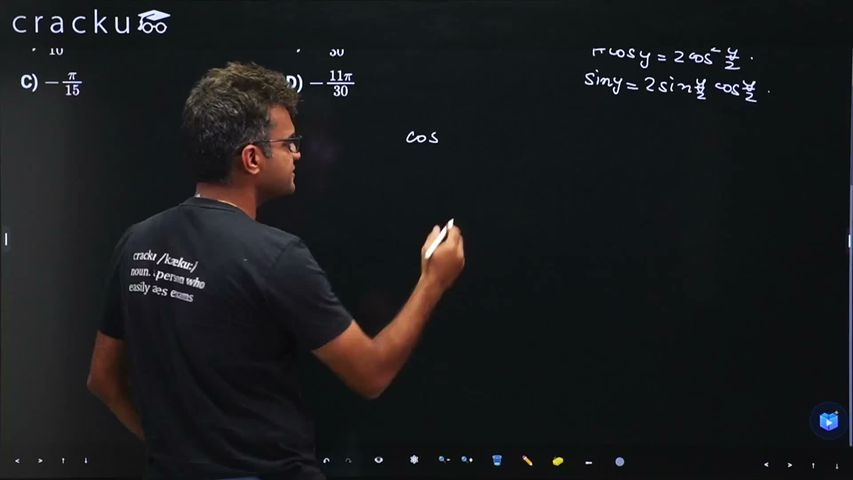
Apply the standard half angle formulas $$\sin \theta = 2\sin(\frac{\theta}{2})\cos(\frac{\theta}{2})$$ and $$1 + \cos \theta = 2\cos^2(\frac{\theta}{2})$$:
$$\text{LHS} = \frac{2\sin\left(\frac{\pi}{4} - \frac{x}{2}\right)\cos\left(\frac{\pi}{4} - \frac{x}{2}\right)}{2\cos^2\left(\frac{\pi}{4} - \frac{x}{2}\right)}$$
Cancel the common terms to simplify:
$$\text{LHS} = \tan\left(\frac{\pi}{4} - \frac{x}{2}\right)$$
Step 2: Set up the Absolute Value Cases
Substitute the simplified Left Hand Side back into the original equation:
$$\tan\left(\frac{\pi}{4} - \frac{x}{2}\right) = |\tan 2x|$$
Because of the absolute value modulus, we must split this into two separate cases to find all possible roots.
Step 3: Solve Case I
Assume the value inside the modulus is positive:
$$\tan\left(\frac{\pi}{4} - \frac{x}{2}\right) = \tan 2x$$
Using the general solution for tangent equations $$\tan A = \tan B \implies A = n\pi + B$$:
$$2x = n\pi + \frac{\pi}{4} - \frac{x}{2}$$
$$\frac{5x}{2} = n\pi + \frac{\pi}{4}$$
$$\frac{5x}{2} = \frac{(4n+1)\pi}{4}$$
$$x = \frac{(4n+1)\pi}{10}$$
Now, substitute integers for $$n$$ to find roots strictly within the interval $$(-\frac{\pi}{2}, \frac{\pi}{2})$$ excluding $$\pm\frac{\pi}{4}$$:
The valid roots from this first case are $$\frac{\pi}{10}$$ and $$-\frac{3\pi}{10}$$.
Step 4: Solve Case II
Assume the value inside the modulus is negative:
$$\tan\left(\frac{\pi}{4} - \frac{x}{2}\right) = -\tan 2x$$
Push the negative sign inside the tangent function:
$$\tan\left(\frac{\pi}{4} - \frac{x}{2}\right) = \tan(-2x)$$
Apply the general trigonometric solution again:
$$-2x = n\pi + \frac{\pi}{4} - \frac{x}{2}$$
$$-\frac{3x}{2} = n\pi + \frac{\pi}{4}$$
$$-\frac{3x}{2} = \frac{(4n+1)\pi}{4}$$
$$x = -\frac{(4n+1)\pi}{6}$$
Check for valid roots within the given interval $$(-\frac{\pi}{2}, \frac{\pi}{2})$$:
The only valid root from this second case is $$-\frac{\pi}{6}$$.
Step 5: Calculate the Final Sum
Add all the valid mathematical solutions together:
$$\text{Sum} = \frac{\pi}{10} + \left(-\frac{3\pi}{10}\right) + \left(-\frac{\pi}{6}\right)$$
$$\text{Sum} = -\frac{2\pi}{10} - \frac{\pi}{6}$$
$$\text{Sum} = -\frac{\pi}{5} - \frac{\pi}{6}$$
Take the common denominator of 30 to finalize the addition:
$$\text{Sum} = \frac{-6\pi - 5\pi}{30}$$
$$\text{Sum} = -\frac{11\pi}{30}$$
The final sum of all valid solutions is exactly $$-\frac{11\pi}{30}$$.
Was this solution helpful?
Click on the Email ☝️ to Watch the Video Solution
Create a FREE account and get:
_1.webp)

Educational materials for JEE preparation

Ask our AI anything

AI can make mistakes. Please verify important information.
AI can make mistakes. Please verify important information.
