
Join Our JEE Preparation Group
Prep with like-minded aspirants; Get access to free daily tests and study material.
Sign in
Please select an account to continue using cracku.in
↓ →
Join Our JEE Preparation Group
Prep with like-minded aspirants; Get access to free daily tests and study material.
If $$^{20}C_r$$ is the co-efficient of $$x^r$$ in the expansion of $$(1 + x)^{20}$$, then the value of $$\sum_{r=0}^{20} r^2(^{20}C_r) $$ is equal to:
We are asked to find the value of the summation $$\displaystyle\sum_{r=0}^{20} r^{2}\binom{20}{r}$$ where $$\binom{20}{r}$$ is the coefficient of $$x^{r}$$ in the binomial expansion of $$(1+x)^{20}$$. Our task is purely algebraic, so we shall begin by recalling two standard binomial identities that come directly from the Binomial Theorem.
First, the Binomial Theorem states that
$$ (1+x)^{n} \;=\; \sum_{r=0}^{n} \binom{n}{r}\,x^{r}. $$
Now, two very useful consequences of this theorem are obtained by differentiating and then manipulating these expansions.
Identity 1 (Sum of first powers):
$$\sum_{r=0}^{n} r\binom{n}{r} \;=\; n\,2^{\,n-1}.$$
Identity 2 (Sum of product of consecutive integers):
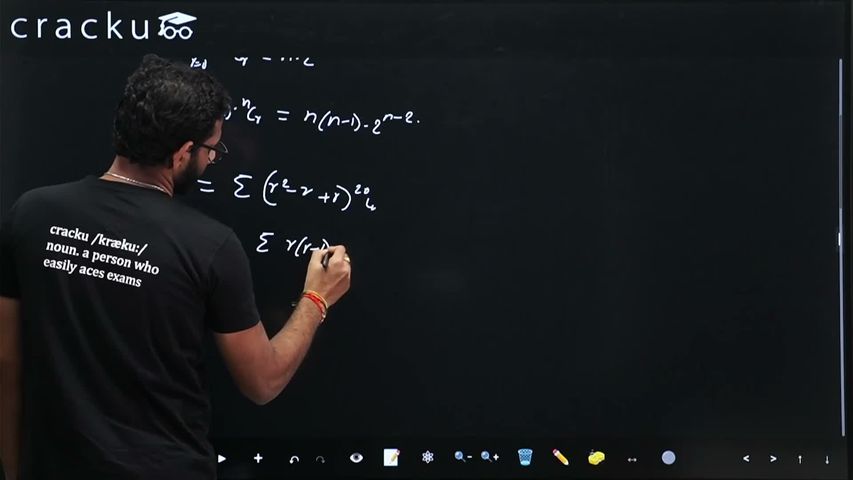
$$\sum_{r=0}^{n} r(r-1)\binom{n}{r} \;=\; n(n-1)\,2^{\,n-2}.$$
We will use both identities. Observe that every term $$r^{2}$$ can be split as
$$r^{2} \;=\; r(r-1)\;+\;r.$$
Hence, for every $$r$$,
$$ r^{2}\binom{20}{r} \;=\; \bigl[r(r-1)\bigr]\binom{20}{r} \;+\; r\binom{20}{r}. $$
Adding term-by-term from $$r=0$$ to $$r=20$$ we have
$$ \sum_{r=0}^{20} r^{2}\binom{20}{r} \;=\; \sum_{r=0}^{20} r(r-1)\binom{20}{r} \;+\; \sum_{r=0}^{20} r\binom{20}{r}. $$
We can now invoke the two identities with $$n=20$$.
Using Identity 2 with $$n=20$$ gives
$$\sum_{r=0}^{20} r(r-1)\binom{20}{r} \;=\; 20\,(20-1)\,2^{\,20-2} \;=\; 20\times19\times2^{18}. $$
Using Identity 1 with $$n=20$$ gives
$$\sum_{r=0}^{20} r\binom{20}{r} \;=\; 20\,2^{\,20-1} \;=\; 20\times2^{19}. $$
Let us place both expressions over the same power of two so we can add them conveniently. Notice that $$2^{19}=2\cdot2^{18}$$. Therefore
$$ 20\times2^{19} \;=\; 20\times2\cdot2^{18} \;=\; 40\times2^{18}. $$
Now we combine the two partial sums:
$$\bigl[20\times19\times2^{18}\bigr] \;+\; \bigl[40\times2^{18}\bigr] \;=\; \bigl[20\times19 + 40\bigr]\,2^{18}.$$
Carrying out the arithmetic inside the bracket,
$$20\times19 \;=\; 380,$$
and hence
$$380 + 40 \;=\; 420.$
Substituting this total back, we obtain
$$\sum_{r=0}^{20} r^{2}\binom{20}{r} \;=\; 420\times2^{18}.$$
Therefore the given summation equals $$420\times2^{18}$$.
Hence, the correct answer is Option A.
Was this solution helpful?
Click on the Email ☝️ to Watch the Video Solution
Create a FREE account and get:
_1.webp)

Educational materials for JEE preparation

Ask our AI anything

AI can make mistakes. Please verify important information.
AI can make mistakes. Please verify important information.
