
Join Our JEE Preparation Group
Prep with like-minded aspirants; Get access to free daily tests and study material.
Sign in
Please select an account to continue using cracku.in
↓ →
Join Our JEE Preparation Group
Prep with like-minded aspirants; Get access to free daily tests and study material.
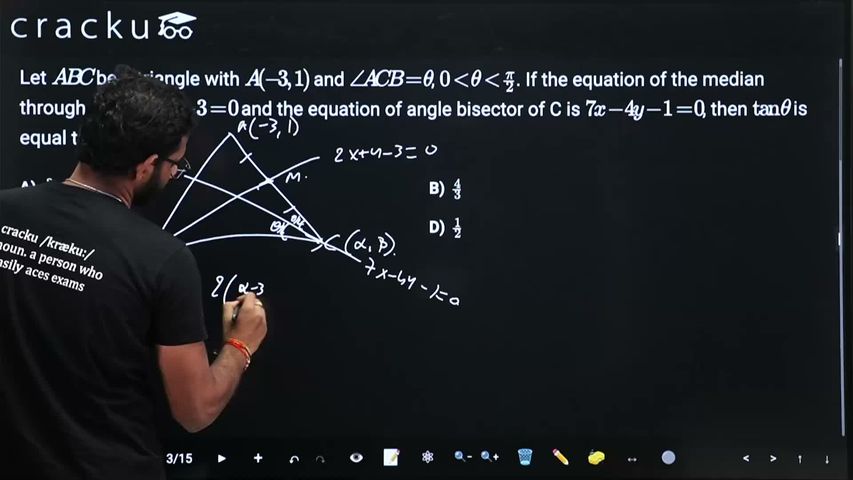
Let $$ABC$$ be a triangle with $$A(-3, 1)$$ and $$\angle ACB = \theta$$, $$0 < \theta < \frac{\pi}{2}$$. If the equation of the median through B is $$2x + y - 3 = 0$$ and the equation of angle bisector of C is $$7x - 4y - 1 = 0$$, then $$\tan \theta$$ is equal to:
Let the vertices be $$A(-3,1),\;B(x_B,y_B),\;C(x_C,y_C)$$.
The given data translate to the following two straight-line conditions:
• Median through $$B$$: $$2x+y-3=0$$ $$\;-(1)$$ (passes through $$B$$ and the midpoint of $$AC$$).
• Angle bisector at $$C$$: $$7x-4y-1=0$$ $$\;-(2)$$ (passes through $$C$$).
Step 1: Find the coordinates of $$C$$
The midpoint of $$AC$$ is $$M\Bigl(\dfrac{-3+x_C}{2},\,\dfrac{1+y_C}{2}\Bigr)$$. Because the median through $$B$$ also contains $$M$$, substitute $$M$$ in $$(1)$$:
$$2\left(\dfrac{-3+x_C}{2}\right)+\dfrac{1+y_C}{2}-3=0$$ $$\Longrightarrow\;(-3+x_C)+\dfrac{1+y_C}{2}-3=0$$ $$\Longrightarrow\;x_C-6+\dfrac{1+y_C}{2}=0$$ $$\Longrightarrow\;2x_C+y_C-11=0$$ $$\;-(3)$$
The point $$C$$ also lies on the bisector $$(2)$$: $$7x_C-4y_C-1=0$$ $$\;-(4)$$.
Solve $$(3)$$ and $$(4)$$ simultaneously:
From $$(3)$$, $$y_C=11-2x_C$$.
Insert in $$(4)$$: $$7x_C-4(11-2x_C)-1=0$$
$$\Rightarrow 7x_C-44+8x_C-1=0$$
$$\Rightarrow 15x_C=45\;\Longrightarrow\;x_C=3$$
$$\Rightarrow y_C=11-2(3)=5$$.
Hence $$C(3,5)$$.
Step 2: Slope of side $$CA$$
$$m_{CA}=\dfrac{5-1}{\,3-(-3)\,}= \dfrac{4}{6}= \dfrac{2}{3}.$$
Step 3: Slope of the angle-bisector at $$C$$
Rewrite $$(2)$$: $$4y=7x-1 \;\Longrightarrow\; y=\dfrac{7}{4}x-\dfrac{1}{4}$$, so $$m_{\text{bis}}=\dfrac{7}{4}.$$
Step 4: Angle between $$CA$$ and the bisector
For two lines with slopes $$m_1,\,m_2$$ the acute angle $$\phi$$ between them is $$\tan\phi=\left|\dfrac{m_2-m_1}{1+m_1m_2}\right|.$$ Here $$\tan\phi=\left|\dfrac{\dfrac{7}{4}-\dfrac{2}{3}}{1+\dfrac{2}{3}\cdot\dfrac{7}{4}}\right| =\dfrac{\dfrac{13}{12}}{\dfrac{13}{6}}=\dfrac{1}{2}.$$
Thus $$\phi=\arctan\!\left(\dfrac{1}{2}\right).$$
Step 5: Obtain $$\theta$$ from the angle bisector property
The line $$(2)$$ is the internal angle bisector at $$C$$; hence it divides the angle $$\angle ACB$$ into two equal parts. Therefore $$\theta=2\phi$$.
Using the double-angle identity $$\tan(2\phi)=\dfrac{2\tan\phi}{1-\tan^2\phi}$$, take $$\tan\phi=\dfrac{1}{2}$$:
$$\tan\theta=\dfrac{2\cdot\dfrac{1}{2}}{1-\left(\dfrac{1}{2}\right)^2} =\dfrac{1}{\,1-\dfrac{1}{4}\,}=\dfrac{1}{\dfrac{3}{4}}=\dfrac{4}{3}.$$
Answer: $$\displaystyle \tan\theta=\dfrac{4}{3}$$ (Option B).
Was this solution helpful?
Click on the Email ☝️ to Watch the Video Solution
Create a FREE account and get:
_1.webp)

Educational materials for JEE preparation

Ask our AI anything

AI can make mistakes. Please verify important information.
AI can make mistakes. Please verify important information.
