
Join Our JEE Preparation Group
Prep with like-minded aspirants; Get access to free daily tests and study material.
Sign in
Please select an account to continue using cracku.in
↓ →
Join Our JEE Preparation Group
Prep with like-minded aspirants; Get access to free daily tests and study material.
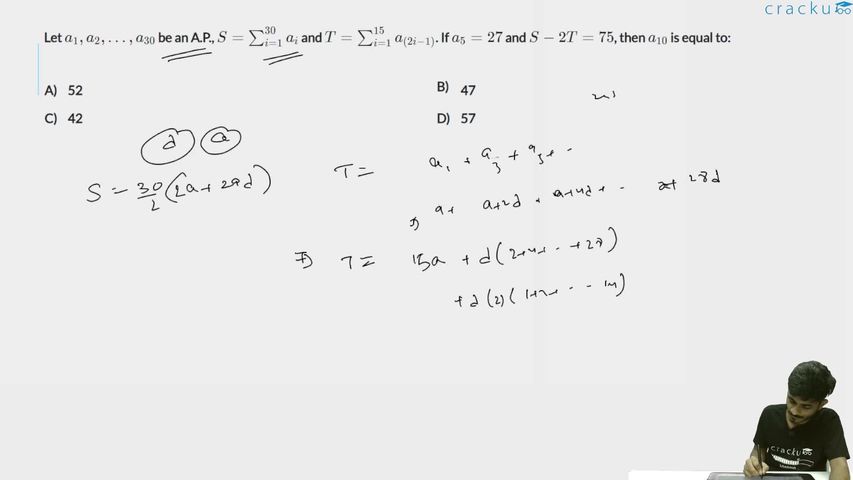
Let $$a_1, a_2, \ldots, a_{30}$$ be an A.P., $$S = \sum_{i=1}^{30} a_i$$ and $$T = \sum_{i=1}^{15} a_{(2i-1)}$$. If $$a_5 = 27$$ and $$S - 2T = 75$$, then $$a_{10}$$ is equal to:
Let us denote the first term of the arithmetic progression by $$a$$ and the common difference by $$d$$. Then, by definition of an A.P., the $$n^{\text{th}}$$ term is given by the well-known formula
$$a_n = a + (n-1)d.$$
We are told that $$a_5 = 27$$. Substituting $$n = 5$$ in the above expression, we obtain
$$a + (5-1)d = 27 \; \Longrightarrow \; a + 4d = 27. \quad -(1)$$
Next, let us write the expression for the sum of the first $$30$$ terms. For an arithmetic progression, the sum of the first $$N$$ terms is
$$S_N = \dfrac{N}{2}\bigl(2a + (N-1)d\bigr).$$
Putting $$N = 30$$, we get
$$S = S_{30} = \dfrac{30}{2}\bigl(2a + 29d\bigr) = 15\bigl(2a + 29d\bigr). \quad -(2)$$
Now we look at $$T = \displaystyle\sum_{i=1}^{15} a_{(2i-1)}$$, i.e. the sum of the odd-indexed terms $$a_1, a_3, a_5, \ldots, a_{29}$$. Observe that these are themselves in arithmetic progression:
$$a_1 = a,$$
$$a_3 = a + 2d,$$
$$a_5 = a + 4d,$$
and so on, the common difference being $$2d$$ and the number of terms being $$15$$.
Therefore, applying the same sum formula with first term $$a' = a$$, common difference $$d' = 2d$$ and number of terms $$N' = 15$$, we have
$$T = \dfrac{15}{2}\bigl(2a' + (15-1)d'\bigr) = \dfrac{15}{2}\bigl(2a + 28d\bigr) = 15\bigl(a + 14d\bigr). \quad -(3)$$
The statement of the problem gives us the relation $$S - 2T = 75$$. Substituting the expressions (2) and (3) into this equation, we get
$$15\bigl(2a + 29d\bigr) - 2\bigl[15\bigl(a + 14d\bigr)\bigr] = 75.$$
Simplifying step by step,
$$15(2a + 29d) - 30(a + 14d) = 75,$$
$$\bigl(30a + 435d\bigr) - \bigl(30a + 420d\bigr) = 75,$$
$$30a + 435d - 30a - 420d = 75,$$
$$15d = 75.$$
Dividing by $$15$$ gives
$$d = 5. \quad -(4)$$
We now return to equation (1), $$a + 4d = 27$$. Substituting the value of $$d$$ from (4), we obtain
$$a + 4(5) = 27 \;\Longrightarrow\; a + 20 = 27 \;\Longrightarrow\; a = 7. \quad -(5)$$
Finally, we require $$a_{10}$$. Using the nth-term formula once more with $$n = 10$$,
$$a_{10} = a + (10-1)d = a + 9d.$$
Substituting $$a = 7$$ and $$d = 5$$, we find
$$a_{10} = 7 + 9 \times 5 = 7 + 45 = 52.$$
Hence, the correct answer is Option A.
Was this solution helpful?
Click on the Email ☝️ to Watch the Video Solution
Create a FREE account and get:
_1.webp)

Educational materials for JEE preparation

Ask our AI anything

AI can make mistakes. Please verify important information.
AI can make mistakes. Please verify important information.
