
Join Our JEE Preparation Group
Prep with like-minded aspirants; Get access to free daily tests and study material.
Sign in
Please select an account to continue using cracku.in
↓ →
Join Our JEE Preparation Group
Prep with like-minded aspirants; Get access to free daily tests and study material.
If $$a$$, $$b$$ and $$c$$ be three distinct real numbers in G.P. and $$a + b + c = xb$$, then $$x$$ cannot be:
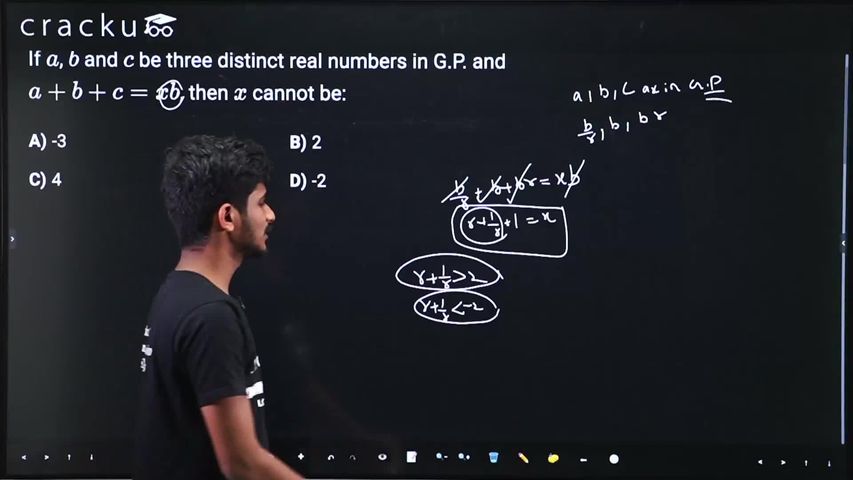
Let the three distinct real numbers $$a$$, $$b$$ and $$c$$ be in geometric progression. For a G.P. we write every term in terms of the middle term and the common ratio. So, if the common ratio is $$r\;(\;r\neq0\;),$$ we have
$$a=\frac{b}{r},\qquad b=b,\qquad c=br.$$
The question gives the relation $$a+b+c=xb$$. Substituting the expressions for $$a$$ and $$c$$ we obtain
$$\frac{b}{r}+b+br = xb.$$
Since $$b\neq0$$ (otherwise the three numbers would all be zero and not distinct), we divide every term by $$b$$:
$$\frac{1}{r}+1+r = x.$$
So,
$$x=r+\frac{1}{r}+1.$$
Now we must find the set of all real values taken by the expression $$r+\dfrac{1}{r}$$ for $$r\in\mathbb{R},\;r\neq0$$.
Using the well-known inequality for real numbers, $$r+\frac{1}{r}\ge 2$$ when $$r>0$$ and $$r+\frac{1}{r}\le -2$$ when $$r<0$$. (Proof: multiply by $$r$$ and bring all terms to one side to get the square of a real number.)
Hence,
$$r+\frac{1}{r}\in(-\infty,-2] \;\cup\; [2,\infty).$$
Adding $$1$$ throughout (because we have $$x=r+\dfrac{1}{r}+1$$) shifts the entire set by $$1$$:
$$x\in(-\infty,-1] \;\cup\; [3,\infty).$$
Thus every real value of $$x$$ is possible except those lying strictly between $$-1$$ and $$3$$.
The four given options are $$-3,\;2,\;4,\;-2$$. Among these, $$-3$$ is ≤$$-1$$, $$4$$ is ≥$$3$$ and $$-2$$ is ≤$$-1$$, so all three can occur. However, $$2$$ lies between $$-1$$ and $$3$$, which is outside the attainable range of $$x$$.
Hence, the correct answer is Option B.
Was this solution helpful?
Click on the Email ☝️ to Watch the Video Solution
Create a FREE account and get:
_1.webp)

Educational materials for JEE preparation

Ask our AI anything

AI can make mistakes. Please verify important information.
AI can make mistakes. Please verify important information.
