
Join Our JEE Preparation Group
Prep with like-minded aspirants; Get access to free daily tests and study material.
Sign in
Please select an account to continue using cracku.in
↓ →
Join Our JEE Preparation Group
Prep with like-minded aspirants; Get access to free daily tests and study material.
We are asked to evaluate the definite integral
$$I=\int_{-\pi}^{\pi}\,|\;\pi-|x|\;|\,dx.$$
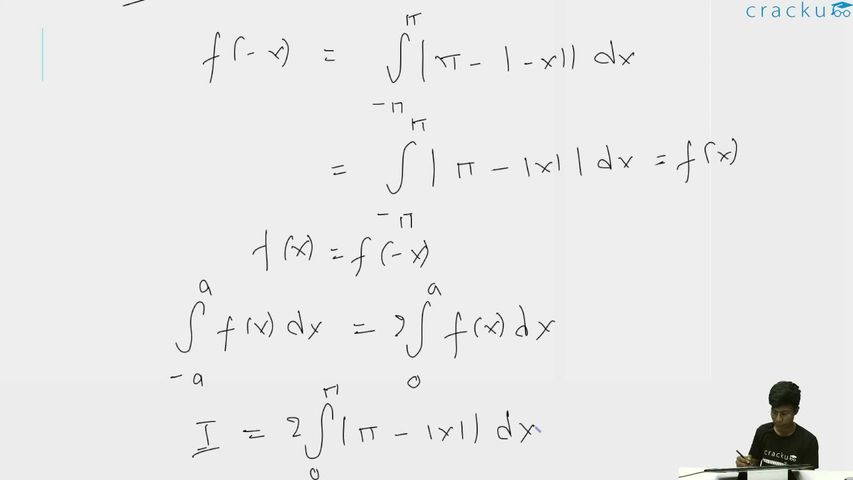
First, notice that the integrand contains the expression $$|x|.$$ This quantity depends only on the distance of $$x$$ from the origin, so it is an even function; that is, $$|{-x}|=|x|.$$ Now the outer absolute-value sign encloses $$\pi-|x|,$$ and the entire function $$|\pi-|x||$$ therefore also depends only on $$|x|.$$ Consequently the whole integrand is even:
$$|\pi-|{-x}||=|\pi-|x||.$$
For an even function $$f(x),$$ the standard property of definite integrals tells us
$$\int_{-a}^{a} f(x)\,dx = 2\int_{0}^{a} f(x)\,dx.$$
We apply this with $$a=\pi$$ and $$f(x)=|\pi-|x||.$$ Therefore,
$$I = 2\int_{0}^{\pi} |\pi-|x||\,dx.$$
Inside the interval $$0\le x\le\pi,$$ we have $$|x|=x.$$ Since $$x\le\pi,$$ the difference $$\pi-x$$ is non-negative, so the inner absolute value does not alter the sign. Thus, on $$[0,\pi]$$
$$|\pi-|x|| = |\pi - x| = \pi - x.$$
Substituting this simplified form into the integral, we get
$$I = 2\int_{0}^{\pi} (\pi - x)\,dx.$$
We now integrate term by term. The antiderivative of a constant $$\pi$$ is $$\pi x,$$ and the antiderivative of $$x$$ is $$\dfrac{x^{2}}{2}.$$ Hence, using the Fundamental Theorem of Calculus,
$$\int_{0}^{\pi} (\pi - x)\,dx = \left[\pi x - \frac{x^{2}}{2}\right]_{0}^{\pi}.$$
Evaluating at the limits, we have
$$\left[\pi x - \frac{x^{2}}{2}\right]_{0}^{\pi} = \left(\pi\cdot\pi - \frac{\pi^{2}}{2}\right) - \left(\pi\cdot 0 - \frac{0^{2}}{2}\right) = \pi^{2} - \frac{\pi^{2}}{2} = \frac{\pi^{2}}{2}.$$
Now we multiply by the outer factor of $$2$$ that came from the even-function property:
$$I = 2 \times \frac{\pi^{2}}{2} = \pi^{2}.$$
Hence, the correct answer is Option 3.
Was this solution helpful?
Click on the Email ☝️ to Watch the Video Solution
Create a FREE account and get:
_1.webp)

Educational materials for JEE preparation

Ask our AI anything

AI can make mistakes. Please verify important information.
AI can make mistakes. Please verify important information.
