
Join Our JEE Preparation Group
Prep with like-minded aspirants; Get access to free daily tests and study material.
Sign in
Please select an account to continue using cracku.in
↓ →
Join Our JEE Preparation Group
Prep with like-minded aspirants; Get access to free daily tests and study material.
The area (in sq. units) of the region $$\{(x, y) : 0 \leq y \leq x^2 + 1, 0 \leq y \leq x + 1, \frac{1}{2} \leq x \leq 2\}$$ is
We are asked to find the area of the set of all points $$(x,y)$$ that simultaneously satisfy $$0 \le y \le x^{2}+1,\; 0 \le y \le x+1,\; \dfrac12 \le x \le 2.$$
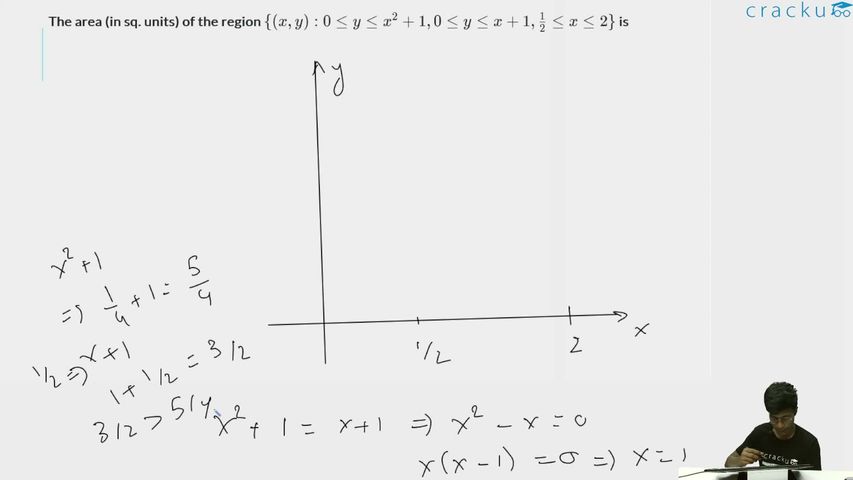
Because both inequalities start with the same lower bound $$y=0,$$ the effective upper bound for each fixed $$x$$ will be the smaller (i.e. the minimum) of the two curves $$y=x^{2}+1$$ and $$y=x+1.$$ Hence, for every $$x$$ the height of the vertical strip contributing to the area is $$\min\{x^{2}+1,\;x+1\}.$$
In order to integrate, we must first determine on which part of the interval $$\left[\dfrac12,2\right]$$ the parabola $$x^{2}+1$$ lies below the straight line $$x+1,$$ and on which part the line lies below the parabola. To do that, we set the two expressions equal:
$$x^{2}+1 = x+1 \Longrightarrow x^{2}-x = 0 \Longrightarrow x(x-1)=0.$$
Thus the two curves intersect at $$x=0$$ and $$x=1.$$ Only $$x=1$$ falls inside our interval $$\left[\dfrac12,2\right].$$ Therefore:
Hence the required area $$A$$ is the sum of two integrals:
$$A = \int_{\frac12}^{1} (x^{2}+1)\,dx \;+\; \int_{1}^{2} (x+1)\,dx.$$
We now evaluate each integral, showing every algebraic step.
First integral:
$$\int_{\frac12}^{1} (x^{2}+1)\,dx = \left[\frac{x^{3}}{3}\right]_{\frac12}^{1} + \left[x\right]_{\frac12}^{1}.$$
For the $$x^{3}/3$$ term we have $$\dfrac{1^{3}}{3} - \dfrac{\left(\frac12\right)^{3}}{3} = \dfrac{1}{3} - \dfrac{1}{24} = \dfrac{8}{24} - \dfrac{1}{24} = \dfrac{7}{24}.$$
For the $$x$$ term we have $$1 - \dfrac12 = \dfrac12.$$
Adding these two contributions gives
$$\int_{\frac12}^{1} (x^{2}+1)\,dx = \dfrac{7}{24} + \dfrac12 = \dfrac{7}{24} + \dfrac{12}{24} = \dfrac{19}{24}.$$
Second integral:
$$\int_{1}^{2} (x+1)\,dx = \int_{1}^{2} x\,dx + \int_{1}^{2} 1\,dx = \left[\frac{x^{2}}{2}\right]_{1}^{2} + \left[x\right]_{1}^{2}.$$
For the $$x^{2}/2$$ term we get $$\dfrac{2^{2}}{2} - \dfrac{1^{2}}{2} = \dfrac{4}{2} - \dfrac{1}{2} = 2 - \dfrac12 = \dfrac32.$$
For the $$x$$ term we get $$2 - 1 = 1.$$
Thus
$$\int_{1}^{2} (x+1)\,dx = \dfrac32 + 1 = \dfrac52.$$
Finally, adding the two parts of the area we obtain
$$A = \dfrac{19}{24} + \dfrac52 = \dfrac{19}{24} + \dfrac{60}{24} = \dfrac{79}{24}.$$
Hence, the correct answer is Option B.
Was this solution helpful?
Click on the Email ☝️ to Watch the Video Solution
Create a FREE account and get:
_1.webp)

Educational materials for JEE preparation

Ask our AI anything

AI can make mistakes. Please verify important information.
AI can make mistakes. Please verify important information.
