
Join Our JEE Preparation Group
Prep with like-minded aspirants; Get access to free daily tests and study material.
Sign in
Please select an account to continue using cracku.in
↓ →
Join Our JEE Preparation Group
Prep with like-minded aspirants; Get access to free daily tests and study material.
The function, $$f(x) = (3x - 7)x^{\frac{2}{3}}$$, $$x \in R$$, is increasing for all $$x$$ lying in:
We have the real-valued function
$$f(x)=\,(3x-7)\,x^{\frac23},\qquad x\in\mathbb R.$$
To find where the function is increasing, we must find the sign of its first derivative. A function is increasing wherever $$f'(x)>0.$$ We first compute the derivative.
By the Product Rule, $$\dfrac{d}{dx}[u\;v]=u'\,v+u\,v',$$ with $$u=3x-7,\qquad v=x^{\frac23}.$$
We differentiate each part:
$$u'= \dfrac{d}{dx}(3x-7)=3,$$ $$v'= \dfrac{d}{dx}\!\left(x^{\frac23}\right)=\frac23\,x^{\frac23-1}=\frac23\,x^{-\frac13}.$$
Substituting these into the Product Rule, we obtain
$$ \begin{aligned} f'(x) & = u'\,v+u\,v' \\ & = 3\,x^{\frac23} \;+\;(3x-7)\left(\frac23\,x^{-\frac13}\right). \end{aligned} $$
Now we simplify. Notice that $$x^{\frac23}=x^{-\frac13}\,x,$$ so we can factor out the common $$x^{-\frac13}$$ term:
$$ \begin{aligned} f'(x) & = x^{-\frac13}\!\left[\,3x + \frac23\,(3x-7)\right]. \end{aligned} $$
We next combine the terms inside the brackets. First write everything with a common denominator 3:
$$3x = \frac{9x}{3},\qquad \frac23\,(3x-7)=\frac{2(3x-7)}{3}.$$
Hence,
$$ \begin{aligned} 3x + \frac23(3x-7) &= \frac{9x}{3}+\frac{2(3x-7)}{3}\\[2pt] &= \frac{9x+6x-14}{3}\\[2pt] &= \frac{15x-14}{3}. \end{aligned} $$
Therefore, the derivative becomes
$$ f'(x)=x^{-\frac13}\,\frac{15x-14}{3}. $$
The constant denominator 3 is positive, so the sign of $$f'(x)$$ depends only on the two factors
$$x^{-\frac13}\quad\text{and}\quad(15x-14).$$
Recall that $$x^{-\frac13}=1/x^{\frac13}.$$ The real cube root preserves the sign of $$x,$$ so
The other factor, $$15x-14,$$ changes sign at $$x=\frac{14}{15}.$$ Its sign is
We consider the two regions of $$x$$ separately.
1. Region $$x>0$$. Here $$x^{-\frac13}>0.$$ So $$f'(x)>0$$ when the second factor is positive, i.e.
$$15x-14>0\quad\Longrightarrow\quad x>\frac{14}{15}.$$
Hence, on the positive side the function is increasing for $$x\in\left(\frac{14}{15},\infty\right).$$
2. Region $$x<0$$. Here $$x^{-\frac13}<0.$$ For the product to be positive we now need $$15x-14<0,$$ which is automatically true for every negative $$x.$$ Thus,
$$f'(x)>0\quad\text{for all }x\in(-\infty,0).$$
The derivative is undefined at $$x=0,$$ but that single point does not affect intervals of monotonicity. Collecting the two increasing portions, we conclude that
$$f(x)\text{ is increasing on }(-\infty,0)\cup\left(\frac{14}{15},\infty\right).$$
This set of intervals matches Option A.
Hence, the correct answer is Option A.
Was this solution helpful?
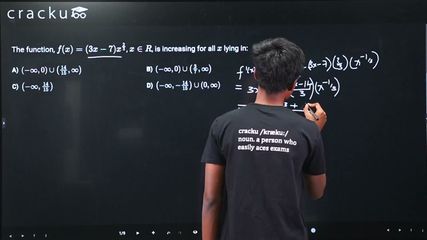
Click on the Email ☝️ to Watch the Video Solution
Create a FREE account and get:
_1.webp)

Educational materials for JEE preparation

Ask our AI anything

AI can make mistakes. Please verify important information.
AI can make mistakes. Please verify important information.
