
Join Our JEE Preparation Group
Prep with like-minded aspirants; Get access to free daily tests and study material.
Sign in
Please select an account to continue using cracku.in
↓ →
Join Our JEE Preparation Group
Prep with like-minded aspirants; Get access to free daily tests and study material.
If $$y^2 + \log_e(\cos^2 x) = y$$, $$x \in \left(-\frac{\pi}{2}, \frac{\pi}{2}\right)$$ then:
We start from the given implicit relation
$$y^2 + \log_e(\cos^2 x) = y,\qquad x\in\left(-\dfrac{\pi}{2},\dfrac{\pi}{2}\right).$$
Re-arranging,
$$y^2 - y + \log_e(\cos^2 x)=0.$$
First we determine the value of $$y$$ at $$x=0$$. Putting $$x=0$$ gives $$\cos 0 =1$$ and hence $$\log_e(\cos^2 0)=\log_e 1 =0$$. The equation reduces to
$$y^2 - y =0 \;\Longrightarrow\; y(y-1)=0,$$
so $$y(0)=0$$ or $$y(0)=1$$. Both roots are admissible; we shall keep the symbol $$y(0)$$ for the moment and let the computation decide the sign of the second derivative later, because the final result involves an absolute value.
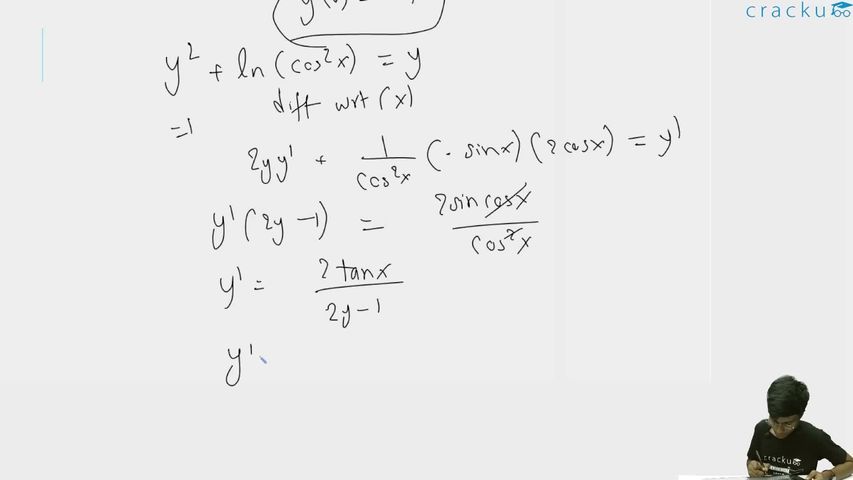
To obtain derivatives we differentiate the implicit equation. Throughout, we treat $$y$$ as a function of $$x$$ and write $$y'=dy/dx,\; y''=d^2y/dx^2$$.
First derivative - We differentiate
$$y^2 - y + \log_e(\cos^2 x)=0$$
term by term. By the chain rule, $$d(y^2)/dx = 2yy'$$ and $$d(-y)/dx=-y'$$. For the logarithmic term we first recall the formula $$\dfrac{d}{dx}\bigl(\log_e u\bigr)=\dfrac{u'}{u}$$. Taking $$u=\cos^2 x$$ we have $$u'=2\cos x(-\sin x)=-\sin(2x)$$ and $$u=\cos^2 x$$, whence
$$\dfrac{d}{dx}\log_e(\cos^2 x)=\frac{-\sin(2x)}{\cos^2 x} =-\,\frac{2\sin x\cos x}{\cos^2 x}=-2\tan x.$$
Putting these pieces together, the differentiated equation is
$$2yy' - y' - 2\tan x = 0.$$
Collecting the $$y'$$ terms gives
$$(2y-1)y' = 2\tan x,$$
and so
$$y'=\frac{2\tan x}{\,2y-1\,}.$$
At $$x=0$$ we have $$\tan 0 =0$$, while $$2y(0)-1$$ is either $$-1$$ (if $$y(0)=0$$) or $$+1$$ (if $$y(0)=1$$). In either case the numerator is zero, hence
$$y'(0)=0.$$
Second derivative - We now differentiate the relation
$$(2y-1)y' = 2\tan x$$
once more with respect to $$x$$.
Using the product rule,
$$\frac{d}{dx}\bigl[(2y-1)y'\bigr]=(2y-1)y'' + 2y'(y'),$$
because $$d(2y-1)/dx = 2y'$$. On the right, $$d(2\tan x)/dx=2\sec^2 x$$. Therefore,
$$(2y-1)y'' + 2(y')^2 = 2\sec^2 x.$$
We now evaluate at $$x=0$$. We already established $$y'(0)=0$$, while $$\sec 0 =1$$. Hence the term containing $$(y')^2$$ vanishes and we obtain
$$(2y(0)-1)\,y''(0)=2\cdot 1^2=2,$$
so that
$$y''(0)=\frac{2}{\,2y(0)-1\,}.$$
If $$y(0)=1$$ the denominator is $$+1$$ and $$y''(0)=+2$$; if $$y(0)=0$$ the denominator is $$-1$$ and $$y''(0)=-2$$. In either situation the absolute value is the same:
$$|y''(0)| = 2.$$
We have also found $$y'(0)=0$$, so $$|y'(0)|+|y''(0)| = 0+2 = 2,$$ demonstrating that the other numerical options do not match.
Therefore the statement which is always true is $$|y''(0)| = 2$$.
Hence, the correct answer is Option C.
Was this solution helpful?
Click on the Email ☝️ to Watch the Video Solution
Create a FREE account and get:
_1.webp)

Educational materials for JEE preparation

Ask our AI anything

AI can make mistakes. Please verify important information.
AI can make mistakes. Please verify important information.
