
Join Our JEE Preparation Group
Prep with like-minded aspirants; Get access to free daily tests and study material.
Sign in
Please select an account to continue using cracku.in
↓ →
Join Our JEE Preparation Group
Prep with like-minded aspirants; Get access to free daily tests and study material.
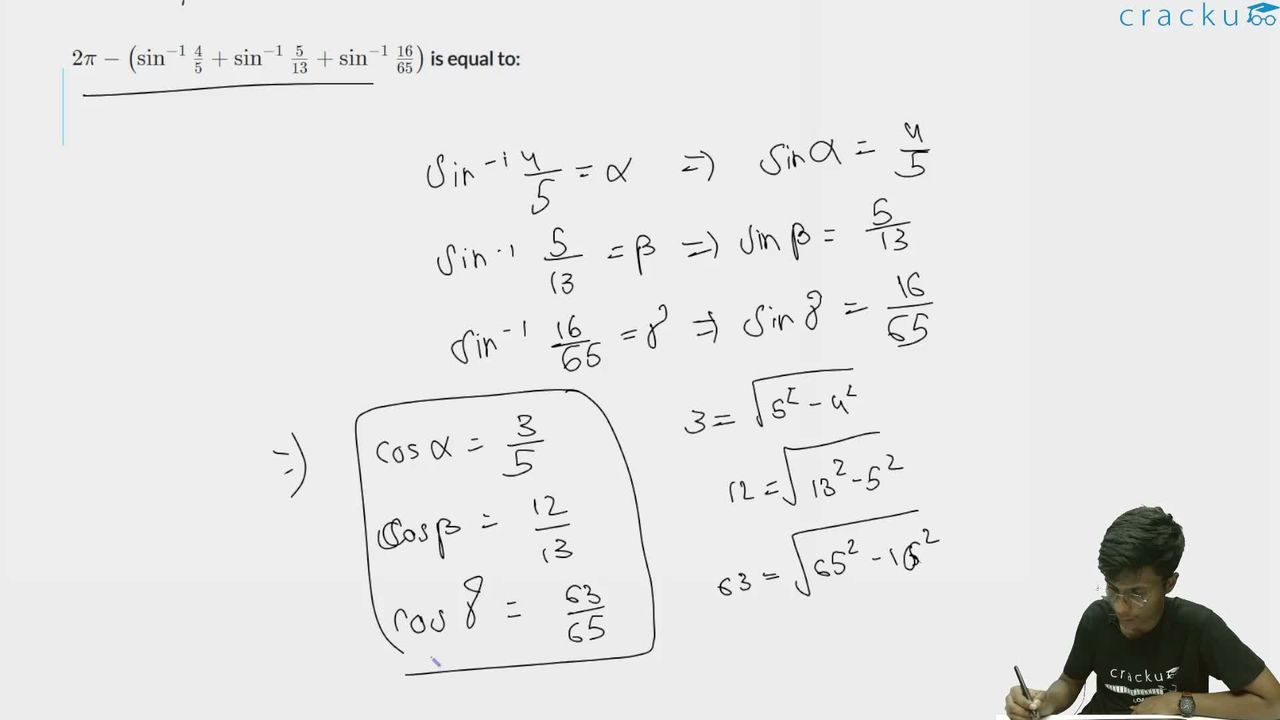
$$2\pi - \left(\sin^{-1}\frac{4}{5} + \sin^{-1}\frac{5}{13} + \sin^{-1}\frac{16}{65}\right)$$ is equal to:
Let us denote
$$\alpha=\sin^{-1}\!\left(\frac45\right),\qquad \beta=\sin^{-1}\!\left(\frac{5}{13}\right),\qquad \gamma=\sin^{-1}\!\left(\frac{16}{65}\right).$$
By definition of inverse sine we immediately have
$$\sin\alpha=\frac45,\qquad \sin\beta=\frac{5}{13},\qquad \sin\gamma=\frac{16}{65}.$$
For every real number $$\theta$$ in the principal domain of $$\sin^{-1}$$ (i.e. $$-\frac\pi2\le\theta\le\frac\pi2$$) we know the Pythagorean identity $$\sin^2\theta+\cos^2\theta=1$$. Hence we can find the corresponding cosines:
$$\cos\alpha=\sqrt{1-\sin^2\alpha}=\sqrt{1-\left(\frac45\right)^2} =\sqrt{1-\frac{16}{25}} =\sqrt{\frac{9}{25}} =\frac35,$$
$$\cos\beta=\sqrt{1-\sin^2\beta}=\sqrt{1-\left(\frac{5}{13}\right)^2} =\sqrt{1-\frac{25}{169}} =\sqrt{\frac{144}{169}} =\frac{12}{13},$$
$$\cos\gamma=\sqrt{1-\sin^2\gamma} =\sqrt{1-\left(\frac{16}{65}\right)^2} =\sqrt{1-\frac{256}{4225}} =\sqrt{\frac{3969}{4225}} =\frac{63}{65}.$$
Now we evaluate the sum $$\alpha+\beta$$ first. The standard angle-addition formula for sine,
$$\sin(A+B)=\sin A\cos B+\cos A\sin B,$$
gives
$$\sin(\alpha+\beta)=\sin\alpha\cos\beta+\cos\alpha\sin\beta =\frac45\cdot\frac{12}{13}+\frac35\cdot\frac{5}{13} =\frac{48}{65}+\frac{15}{65} =\frac{63}{65}.$$
Again using $$\sin^2\theta+\cos^2\theta=1$$ for the angle $$\alpha+\beta$$, its cosine is
$$\cos(\alpha+\beta) =\sqrt{1-\sin^2(\alpha+\beta)} =\sqrt{1-\left(\frac{63}{65}\right)^2} =\sqrt{1-\frac{3969}{4225}} =\sqrt{\frac{256}{4225}} =\frac{16}{65}.$$
We now compare these results with $$\sin\gamma$$ and $$\cos\gamma$$ obtained earlier: we have
$$\sin(\alpha+\beta)=\frac{63}{65}=\cos\gamma,$$
$$\cos(\alpha+\beta)=\frac{16}{65}=\sin\gamma.$$
For acute angles (and each of $$\alpha,\beta,\gamma$$ is indeed acute because their sines are positive and less than 1) the equalities $$\sin X=\cos Y$$ and $$\cos X=\sin Y$$ imply that $$X+Y=\frac\pi2$$. Hence
$$\alpha+\beta+\gamma=\frac\pi2.$$
Substituting this result into the original expression we get
$$2\pi-\left(\sin^{-1}\frac45+\sin^{-1}\frac{5}{13}+\sin^{-1}\frac{16}{65}\right) =2\pi-(\alpha+\beta+\gamma) =2\pi-\frac\pi2 =\frac{3\pi}{2}.$$
Hence, the correct answer is Option C.
Was this solution helpful?
Click on the Email ☝️ to Watch the Video Solution
Create a FREE account and get:
_1.webp)

Educational materials for JEE preparation

Ask our AI anything

AI can make mistakes. Please verify important information.
AI can make mistakes. Please verify important information.
