
Join Our JEE Preparation Group
Prep with like-minded aspirants; Get access to free daily tests and study material.
Sign in
Please select an account to continue using cracku.in
↓ →
Join Our JEE Preparation Group
Prep with like-minded aspirants; Get access to free daily tests and study material.
For $$k \in \mathbb{N}$$, if the sum of the series $$1 + \frac{4}{k} + \frac{8}{k^2} + \frac{13}{k^3} + \frac{19}{k^4} + \ldots$$ is 10, then the value of $$k$$ is
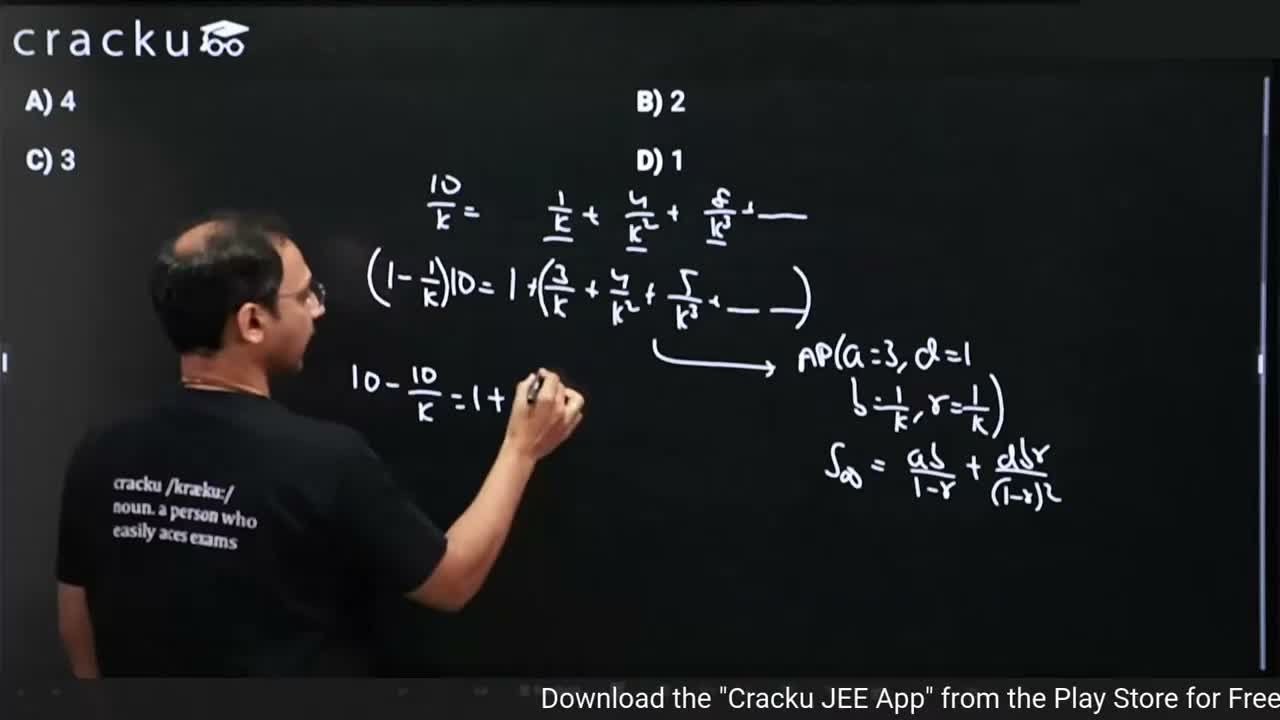
Let, $$S=1+\frac{4}{k}+\frac{8}{k^2}+\frac{13}{k^3}+\frac{19}{k^4}+\cdots$$
Multiplying by $$\frac{1}{k}$$,
$$\frac{S}{k}=\frac{1}{k}+\frac{4}{k^2}+\frac{8}{k^3}+\frac{13}{k^4}+\cdots$$
Subtracting,
$$S-\frac{S}{k}=1+\frac{3}{k}+\frac{4}{k^2}+\frac{5}{k^3}+\frac{6}{k^4}+\cdots$$
$$S\left(1-\frac{1}{k}\right)=1+\frac{3}{k}+\frac{4}{k^2}+\frac{5}{k^3}+\cdots$$
Again multiplying by $$\frac{1}{k}$$,
$$\frac{S}{k}\left(1-\frac{1}{k}\right)=\frac{1}{k}+\frac{3}{k^2}+\frac{4}{k^3}+\frac{5}{k^4}+\cdots$$
Subtracting,
$$S\left(1-\frac{1}{k}\right)^2=1+\frac{2}{k}+\frac{1}{k^2}+\frac{1}{k^3}+\frac{1}{k^4}+\cdots$$
The remaining infinite geometric progression is
$$\frac{1}{k^2}+\frac{1}{k^3}+\frac{1}{k^4}+\cdots$$
with first term $$\frac{1}{k^2}$$ and common ratio $$\frac{1}{k}$$.
Its sum is
$$\frac{\frac{1}{k^2}}{1-\frac{1}{k}}=\frac{1}{k(k-1)}$$
Therefore,
$$S\left(1-\frac{1}{k}\right)^2=1+\frac{2}{k}+\frac{1}{k(k-1)}$$
Taking the LCM on the right side,
$$S\left(\frac{k-1}{k}\right)^2=\frac{k(k-1)+2(k-1)+1}{k(k-1)}$$
$$S\left(\frac{k-1}{k}\right)^2=\frac{k^2+k-1}{k(k-1)}$$
Hence,
$$S=\frac{k(k^2+k-1)}{(k-1)^3}$$
Given that the sum of the series is $$10$$,
$$10=\frac{k(k^2+k-1)}{(k-1)^3}$$
$$10(k-1)^3=k(k^2+k-1)$$
$$10(k^3-3k^2+3k-1)=k^3+k^2-k$$
$$10k^3-30k^2+30k-10=k^3+k^2-k$$
$$9k^3-31k^2+31k-10=0$$
Since $$k\in\mathbb{N}$$, testing natural number values gives
$$k=2$$
because
$$9(2)^3-31(2)^2+31(2)-10=72-124+62-10=0$$
Hence, the correct answer is
$$k=2$$
Was this solution helpful?
Click on the Email ☝️ to Watch the Video Solution
Create a FREE account and get:
_1.webp)

Educational materials for JEE preparation

Ask our AI anything

AI can make mistakes. Please verify important information.
AI can make mistakes. Please verify important information.


