
Join Our JEE Preparation Group
Prep with like-minded aspirants; Get access to free daily tests and study material.
Sign in
Please select an account to continue using cracku.in
↓ →
Join Our JEE Preparation Group
Prep with like-minded aspirants; Get access to free daily tests and study material.
Let $$a_1, a_2, \ldots, a_{21}$$ be an A.P. such that $$\sum_{n=1}^{20} \frac{1}{a_n a_{n+1}} = \frac{4}{9}$$. If the sum of this A.P. is 189, then $$a_6 a_{16}$$ is equal to:
Let us denote the first term of the arithmetic progression by $$a$$ and its common difference by $$d$$. Therefore the general term can be written as $$a_n = a + (n-1)d$$.
First we use the well-known formula for the sum of an A.P. For $$N$$ terms, the sum is $$S_N = \dfrac{N}{2}\,[2a + (N-1)d].$$ Here $$N = 21$$ and the given sum is $$189$$, so
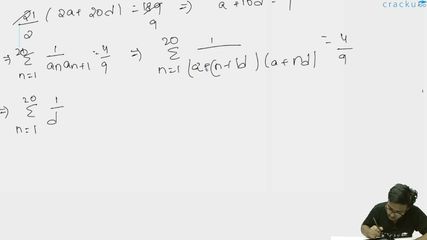
$$\dfrac{21}{2}\,[\,2a + 20d\,] = 189.$$
Multiplying both sides by $$2$$ we obtain $$21\,[\,2a + 20d\,] = 378.$$
Dividing by $$21$$ gives $$2a + 20d = 18.$$
Finally dividing by $$2$$ we get the convenient relation $$a + 10d = 9.\qquad(1)$$
Now we turn to the second piece of information, namely $$\sum_{n=1}^{20} \dfrac{1}{a_n a_{n+1}} = \dfrac{4}{9}.$$
We first note the identity $$\dfrac{1}{x(x+d)} = \dfrac{1}{d}\left(\dfrac{1}{x} - \dfrac{1}{x+d}\right),$$ which can be verified by combining the right-hand side over a common denominator.
Putting $$x = a_n = a + (n-1)d$$, we have $$\dfrac{1}{a_n a_{n+1}} = \dfrac{1}{d}\left(\dfrac{1}{a_n} - \dfrac{1}{a_{n+1}}\right).$$
Hence the required sum is
$$\sum_{n=1}^{20} \dfrac{1}{a_n a_{n+1}} \;=\; \dfrac{1}{d}\sum_{n=1}^{20}\left(\dfrac{1}{a_n} - \dfrac{1}{a_{n+1}}\right).$$
This is a telescoping series: every intermediate term cancels, leaving only the first and the last:
$$\dfrac{1}{d}\left(\dfrac{1}{a_1} - \dfrac{1}{a_{21}}\right).$$
Because $$a_1 = a$$ and $$a_{21} = a + 20d$$, the sum becomes
$$\dfrac{1}{d}\left(\dfrac{1}{a} - \dfrac{1}{a + 20d}\right).$$
Combining the two fractions in the parentheses gives
$$\dfrac{1}{d}\left(\dfrac{a + 20d - a}{a(a + 20d)}\right) = \dfrac{1}{d}\cdot \dfrac{20d}{a(a + 20d)} = \dfrac{20}{a(a + 20d)}.$$
The problem statement tells us this value equals $$\dfrac{4}{9}$$, hence
$$\dfrac{20}{a(a + 20d)} = \dfrac{4}{9}.$$
Cross-multiplying we get $$20 \times 9 = 4 \, a (a + 20d).$$
Thus $$180 = 4\,a(a + 20d),$$ and dividing by $$4$$ yields $$45 = a(a + 20d).\qquad(2)$$
We already have the simpler relation (1): $$a + 10d = 9.$$ Let us make use of it. From (1) we can write
$$d = \dfrac{9 - a}{10}.$$
Now observe that $$a + 20d = a + 2(9 - a) = a + 18 - 2a = 18 - a.$$
Substituting this in equation (2) gives
$$a(18 - a) = 45.$$
Expanding and bringing everything to the left,
$$18a - a^2 - 45 = 0 \quad\Longrightarrow\quad -a^2 + 18a - 45 = 0.$$
Multiplying by $$-1$$ for convenience,
$$a^2 - 18a + 45 = 0.$$
We apply the quadratic formula $$a = \dfrac{-b \pm \sqrt{b^2 - 4ac}}{2a}$$ (with coefficients here being $$1, -18, 45$$):
The discriminant is $$\Delta = (-18)^2 - 4\cdot1\cdot45 = 324 - 180 = 144,$$ whose square root is $$12.$$
Therefore
$$a = \dfrac{18 \pm 12}{2}.$$
This gives two possibilities: $$a = \dfrac{30}{2} = 15 \quad\text{or}\quad a = \dfrac{6}{2} = 3.$$
Correspondingly, using $$d = \dfrac{9 - a}{10},$$ we find
For $$a = 15$$: $$d = \dfrac{9 - 15}{10} = -\dfrac{6}{10} = -\dfrac{3}{5}.$$ For $$a = 3$$: $$d = \dfrac{9 - 3}{10} = \dfrac{6}{10} = \dfrac{3}{5}.$$
Both pairs $$(a,d) = (15,-\tfrac35)$$ and $$(a,d) = (3,\tfrac35)$$ satisfy all given conditions, so we may proceed with either. Because the required product $$a_6 a_{16}$$ involves the same two numbers in either order, it will turn out identical in both cases. We now compute it.
Using the general term $$a_n = a + (n-1)d,$$ we have
$$a_6 = a + 5d, \qquad a_{16} = a + 15d.$$
First choice: $$a = 3,\; d = \dfrac35.$$ Then $$a_6 = 3 + 5\left(\dfrac35\right) = 3 + 3 = 6,$$ $$a_{16} = 3 + 15\left(\dfrac35\right) = 3 + 9 = 12.$$ Hence $$a_6 a_{16} = 6 \times 12 = 72.$$
Second choice: $$a = 15,\; d = -\dfrac35.$$ Now $$a_6 = 15 + 5\left(-\dfrac35\right) = 15 - 3 = 12,$$ $$a_{16} = 15 + 15\left(-\dfrac35\right) = 15 - 9 = 6.$$ Again $$a_6 a_{16} = 12 \times 6 = 72.$$
Thus in every admissible case we obtain the same result:
$$a_6 a_{16} = 72.$$
Hence, the correct answer is Option D.
Click on the Email ☝️ to Watch the Video Solution
Create a FREE account and get:
_1.webp)

Educational materials for JEE preparation

Ask our AI anything

AI can make mistakes. Please verify important information.
AI can make mistakes. Please verify important information.


