
Join Our JEE Preparation Group
Prep with like-minded aspirants; Get access to free daily tests and study material.
Sign in
Please select an account to continue using cracku.in
↓ →
Join Our JEE Preparation Group
Prep with like-minded aspirants; Get access to free daily tests and study material.
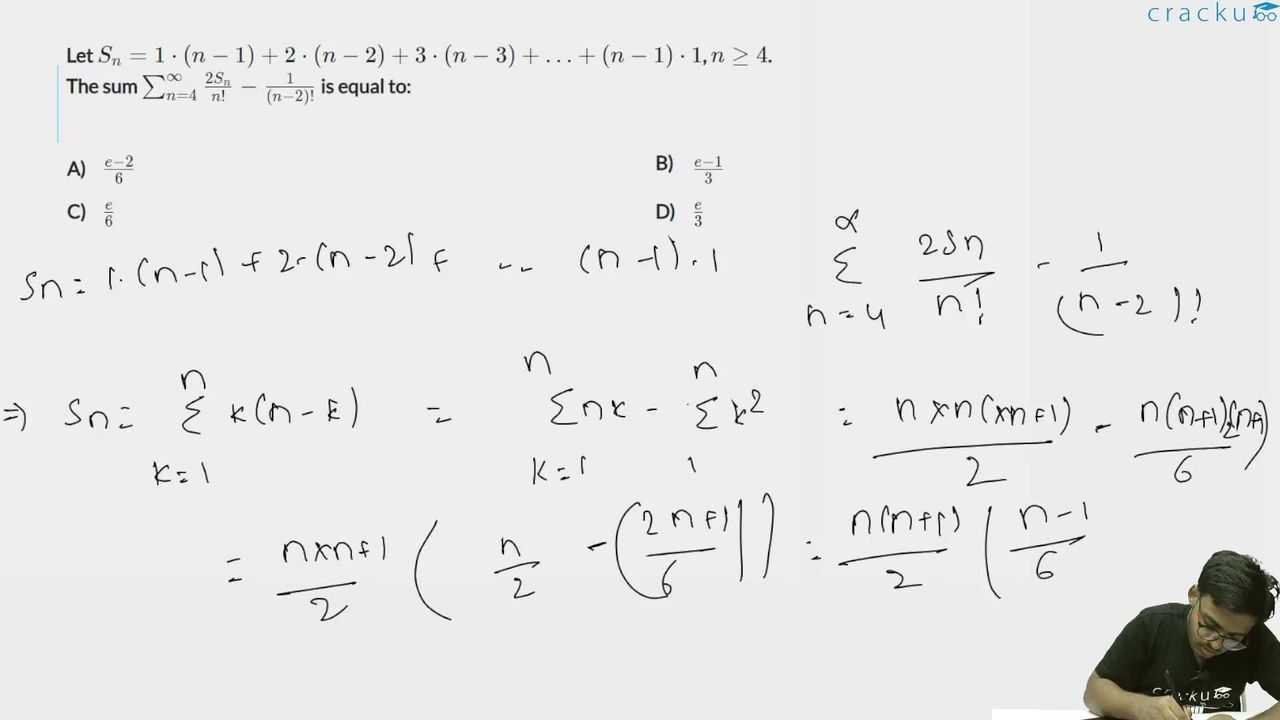
Let $$S_n = 1 \cdot (n-1) + 2 \cdot (n-2) + 3 \cdot (n-3) + \ldots + (n-1) \cdot 1$$, $$n \geq 4$$.
The sum $$\sum_{n=4}^{\infty} \frac{2 S_n}{n!} - \frac{1}{(n-2)!}$$ is equal to:
We have been given the finite sum
$$S_n = 1\,(n-1)+2\,(n-2)+3\,(n-3)+\dots +(n-1)\,1,$$
where $$n\ge 4$$, and we are asked to evaluate the infinite series
$$\sum_{n=4}^{\infty}\left[\frac{2S_n}{n!}-\frac{1}{(n-2)!}\right].$$
First, we find a closed form for $$S_n$$. Write each term of $$S_n$$ in the form $$k\,(n-k)$$, where the index $$k$$ runs from $$1$$ to $$n-1$$. So
$$S_n=\sum_{k=1}^{n-1}k\,(n-k)=\sum_{k=1}^{n-1}\bigl(kn-k^2\bigr).$$
We now separate the two sums:
$$S_n=n\sum_{k=1}^{n-1}k-\sum_{k=1}^{n-1}k^2.$$
We next recall the standard formulas:
• Sum of the first $$m$$ natural numbers: $$\displaystyle\sum_{k=1}^{m}k=\frac{m(m+1)}{2}.$$
• Sum of the squares of the first $$m$$ natural numbers: $$\displaystyle\sum_{k=1}^{m}k^2=\frac{m(m+1)(2m+1)}{6}.$$
Here, $$m=n-1$$. Substituting $$m=n-1$$ into both formulas gives
$$\sum_{k=1}^{n-1}k=\frac{(n-1)n}{2},\qquad \sum_{k=1}^{n-1}k^2=\frac{(n-1)n(2n-1)}{6}.$$
Hence
$$S_n=n\left[\frac{(n-1)n}{2}\right]-\frac{(n-1)n(2n-1)}{6}.$$ Simplifying step by step, we factor out the common factor $$(n-1)n$$:
$$S_n=(n-1)n\left[\frac{n}{2}-\frac{2n-1}{6}\right].$$
Inside the brackets we put everything over a common denominator $$6$$:
$$\frac{n}{2}=\frac{3n}{6},\qquad \frac{3n}{6}-\frac{2n-1}{6}=\frac{3n-2n+1}{6}=\frac{n+1}{6}.$$
Therefore
$$S_n=(n-1)n\left[\frac{n+1}{6}\right]=\frac{(n-1)n(n+1)}{6}.$$
Now we turn to the required general term of the series:
$$\frac{2S_n}{n!}-\frac{1}{(n-2)!} =\frac{2}{n!}\cdot\frac{(n-1)n(n+1)}{6}-\frac{1}{(n-2)!} =\frac{(n-1)n(n+1)}{3\,n!}-\frac{1}{(n-2)!}.$$
Write $$n!$$ as $$n\,(n-1)\,(n-2)!$$ and cancel:
$$\frac{(n-1)n(n+1)}{3\,n!}=\frac{(n-1)n(n+1)}{3\,n\,(n-1)\,(n-2)!} =\frac{n+1}{3\,(n-2)!}.$$
So the entire term becomes
$$\frac{n+1}{3\,(n-2)!}-\frac{1}{(n-2)!} =\left[\frac{n+1}{3}-1\right]\frac{1}{(n-2)!} =\frac{n+1-3}{3}\cdot\frac{1}{(n-2)!} =\frac{n-2}{3}\cdot\frac{1}{(n-2)!}.$$
Notice that for any positive integer $$k$$ we have the identity
$$\frac{k}{k!}=\frac{1}{(k-1)!},$$
because $$k!=k\,(k-1)!.$$ Putting $$k=n-2$$, we get
$$\frac{n-2}{(n-2)!}=\frac{1}{(n-3)!}.$$
Therefore the nth term of our series simplifies beautifully to
$$\frac{1}{3}\cdot\frac{1}{(n-3)!}.$$
Hence the required infinite sum is
$$\sum_{n=4}^{\infty}\left[\frac{2S_n}{n!}-\frac{1}{(n-2)!}\right] =\frac{1}{3}\sum_{n=4}^{\infty}\frac{1}{(n-3)!}.$$
Let us shift the index to expose the familiar Maclaurin expansion of $$e^x$$. Put $$m=n-3\; \Longrightarrow\;n=4\Rightarrow m=1$$. Then
$$\sum_{n=4}^{\infty}\frac{1}{(n-3)!} =\sum_{m=1}^{\infty}\frac{1}{m!}.$$
We recall the well-known series for Euler’s number $$e$$:
$$e=\sum_{m=0}^{\infty}\frac{1}{m!}=1+\sum_{m=1}^{\infty}\frac{1}{m!}.$$
Thus
$$\sum_{m=1}^{\infty}\frac{1}{m!}=e-1.$$
Substituting this result back, we get
$$\sum_{n=4}^{\infty}\left[\frac{2S_n}{n!}-\frac{1}{(n-2)!}\right] =\frac{1}{3}\,(e-1)=\frac{e-1}{3}.$$
Hence, the correct answer is Option B.
Click on the Email ☝️ to Watch the Video Solution
Create a FREE account and get:
_1.webp)

Educational materials for JEE preparation

Ask our AI anything

AI can make mistakes. Please verify important information.
AI can make mistakes. Please verify important information.


