
Join Our JEE Preparation Group
Prep with like-minded aspirants; Get access to free daily tests and study material.
Sign in
Please select an account to continue using cracku.in
↓ →
Join Our JEE Preparation Group
Prep with like-minded aspirants; Get access to free daily tests and study material.
In a geometric progression, if the ratio of the sum of first 5 terms to the sum of their reciprocals is 49, and the sum of the first and the third term is 35. Then the first term of this geometric progression is:
Let us denote the first term of the required geometric progression by $$a$$ and its common ratio by $$r$$.
We are given two separate pieces of information:
1. The ratio of the sum of the first five terms to the sum of the reciprocals of these five terms is $$49{:}1.$$
2. The sum of the first and the third term equals $$35,$$ that is
$$a+ar^{2}=35.$$
We now translate each piece of information into algebra.
Handling the sums of the first five terms
For any geometric progression (when $$r\neq1$$) the sum of the first $$n$$ terms is given by the standard formula
$$S_{n}=a\;\frac{r^{\,n}-1}{r-1}.$$
Hence the sum of the first five terms is
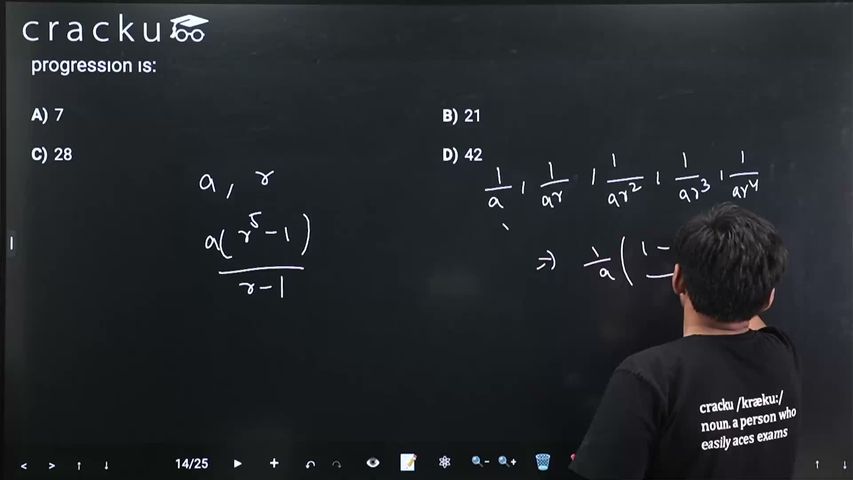
$$S_{5}=a\;\frac{r^{5}-1}{r-1}.$$
The reciprocals of the first five terms are
$$\frac1a,\;\frac1{ar},\;\frac1{ar^{2}},\;\frac1{ar^{3}},\;\frac1{ar^{4}}.$$ These themselves constitute a geometric progression with first term $$\dfrac1a$$ and common ratio $$\dfrac1r.$$
Applying the same sum formula to those reciprocals, we write
$$S'_{5}=\frac1a\;\frac{\left(\dfrac1r\right)^{5}-1}{\dfrac1r-1}.$$
Now we simplify this expression completely, step by step.
First treat the numerator:
$$\left(\dfrac1r\right)^{5}-1=\frac1{r^{5}}-1=\frac{1-r^{5}}{r^{5}}=-\;\frac{r^{5}-1}{r^{5}}.$$
Then the denominator:
$$\dfrac1r-1=\frac{1-r}{r}=-\;\frac{r-1}{r}.$$
Dividing numerator by denominator we obtain
$$\frac{\left(\dfrac1r\right)^{5}-1}{\dfrac1r-1}= \frac{-\dfrac{r^{5}-1}{r^{5}}}{-\dfrac{r-1}{r}} =\frac{r^{5}-1}{r^{5}}\;\frac{r}{r-1} =\frac{r^{5}-1}{r^{4}(r-1)}.$$
Accordingly,
$$S'_{5}=\frac1a\;\frac{r^{5}-1}{r^{4}(r-1)}.$$
Forming the given ratio
The problem states that $$\frac{S_{5}}{S'_{5}}=49.$$ Writing the two sums explicitly gives
$$\frac{\, a\;\dfrac{r^{5}-1}{\,r-1}\,} {\,\dfrac1a\;\dfrac{r^{5}-1}{\,r^{4}(r-1)}\,}=49.$$
Notice that $$r^{5}-1$$ and $$r-1$$ occur in both numerator and denominator and therefore cancel out. We are left with a simple product:
$$a \times a \times r^{4}=49.$$
So
$$a^{2}r^{4}=49.$$
Taking the square root of both sides (and retaining the positive root because the numerical ratio 49 is positive) we obtain
$$a\,r^{2}=7.$$ We shall remember this relation as it will soon combine with the second given condition.
Using the sum of the 1st and 3rd terms
We already know that $$a+ar^{2}=35.$$ Factorising the common $$a$$ gives $$a(1+r^{2})=35.$$
We have two simultaneous relations:
$$\begin{cases} a(1+r^{2})=35,\\[4pt] a\,r^{2}=7. \end{cases}$$
From the second equation we can express $$a$$ in terms of $$r^{2}:$$
$$a=\dfrac{7}{r^{2}}.$$
Substituting this value of $$a$$ into the first equation yields
$$\dfrac{7}{r^{2}}\,(1+r^{2})=35.$$
We divide both sides by 7 to keep the numbers small:
$$\frac{1+r^{2}}{r^{2}}=5.$$
Writing the left-hand side as a single fraction gives $$\frac{1}{r^{2}}+1=5,$$ so $$\frac{1}{r^{2}}=4.$$
Taking reciprocals we arrive at $$r^{2}=\frac14.$$ Consequently $$r=\frac12$$ or $$r=-\frac12.$$ Either choice of sign will deliver the same absolute value for the first term; the question merely asks for that first term.
Return now to $$a=\dfrac{7}{r^{2}}.$$ Substituting $$r^{2}=\dfrac14$$ gives
$$a=\frac{7}{\dfrac14}=7 \times 4 = 28.$$
Thus the first term of the geometric progression is $$28.$$
Hence, the correct answer is Option C.
Was this solution helpful?
Click on the Email ☝️ to Watch the Video Solution
Create a FREE account and get:
_1.webp)

Educational materials for JEE preparation

Ask our AI anything

AI can make mistakes. Please verify important information.
AI can make mistakes. Please verify important information.
