
Join Our JEE Preparation Group
Prep with like-minded aspirants; Get access to free daily tests and study material.
Sign in
Please select an account to continue using cracku.in
↓ →
Join Our JEE Preparation Group
Prep with like-minded aspirants; Get access to free daily tests and study material.
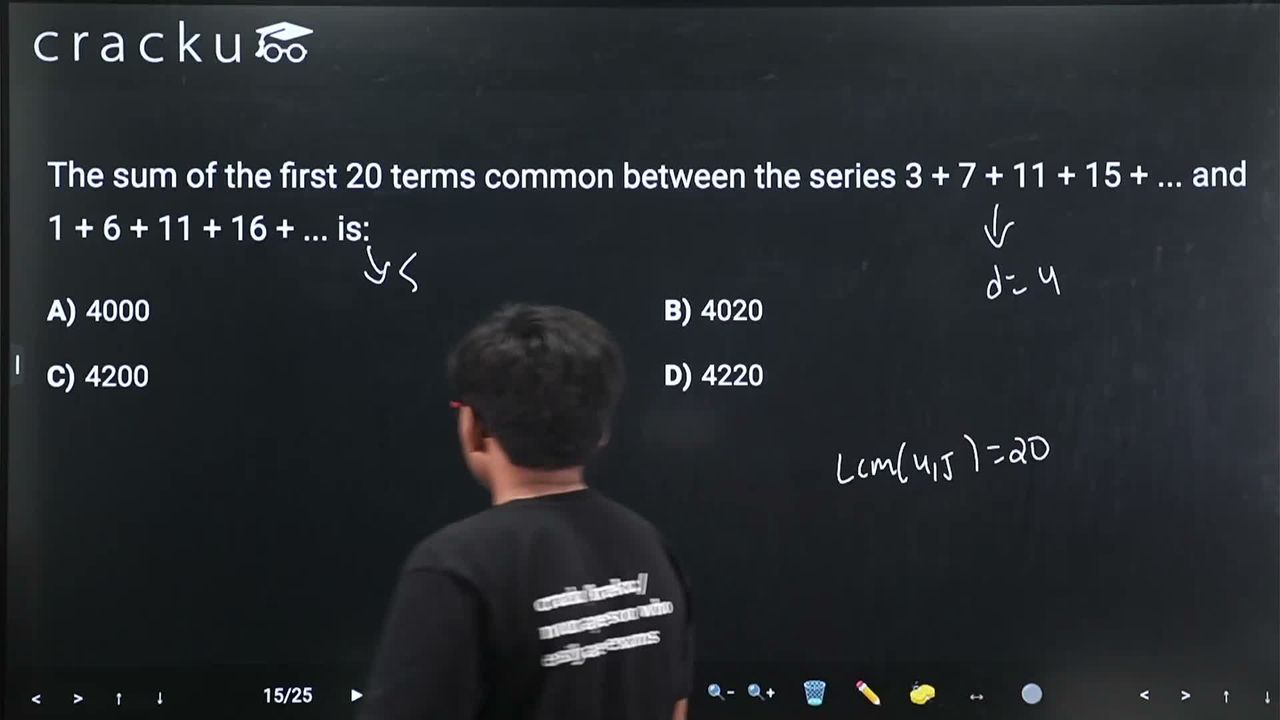
The sum of the first 20 terms common between the series 3 + 7 + 11 + 15 + ... and 1 + 6 + 11 + 16 + ... is:
We have two arithmetic progressions (A.P.s):
First A.P. : $$3,\,7,\,11,\,15,\ldots$$
Second A.P. : $$1,\,6,\,11,\,16,\ldots$$
For any A.P. the general (n-th) term is given by the well-known formula
$$T_n = a + (n-1)d,$$
where $$a$$ is the first term and $$d$$ the common difference.
Applying this formula to the first A.P. we get
$$T_n^{(1)} = 3 + (n-1)\,4.$$
Similarly, for the second A.P. we have
$$T_m^{(2)} = 1 + (m-1)\,5.$$
Now we look for the common terms, that is, all numbers which are simultaneously equal to some $$T_n^{(1)}$$ and some $$T_m^{(2)}$$. Hence we set
$$3 + (n-1)\,4 = 1 + (m-1)\,5.$$
Expanding both sides gives
$$3 + 4n - 4 \;=\; 1 + 5m - 5.$$
Simplifying each side separately,
$$4n - 1 \;=\; 5m - 4.$$
Rearranging terms to group the variables,
$$4n \;=\; 5m - 3.$$
Or, equivalently,
$$5m = 4n + 3.$$
Because the left side $$5m$$ is a multiple of $$5$$, the right side $$4n + 3$$ must also be a multiple of $$5$$. Therefore we impose the divisibility condition
$$4n + 3 \equiv 0 \pmod{5}.$$
Noting that $$4 \equiv -1 \pmod{5},$$ we rewrite the congruence:
$$-n + 3 \equiv 0 \pmod{5}.$$
Which is the same as
$$-n \equiv -3 \pmod{5},$$
and hence
$$n \equiv 3 \pmod{5}.$$
Thus $$n$$ can be expressed as
$$n = 5k + 3,$$
where $$k$$ is any non-negative integer $$k = 0,1,2,\ldots$$.
Substituting this value of $$n$$ back into the expression for the term of the first A.P. we obtain every common term:
$$\begin{aligned} T &= 3 + \bigl[(5k + 3) - 1\bigr]\;4 \\ &= 3 + (5k + 2)\,4 \\ &= 3 + 20k + 8 \\ &= 20k + 11. \end{aligned}$$
So the sequence of all common terms is itself an A.P.:
$$11,\,31,\,51,\,71,\ldots$$
From the form $$20k + 11$$ we see the first common term is $$11$$ and the common difference is $$20$$.
We are asked for the sum of the first $$20$$ such common terms. Hence we take
$$a = 11,\quad d = 20,\quad n = 20.$$
For an A.P. the sum of the first $$n$$ terms is given by the formula
$$S_n = \frac{n}{2}\Bigl[\,2a + (n-1)d\,\Bigr].$$
Substituting $$n = 20,\; a = 11,\; d = 20,$$ we have
$$\begin{aligned} S_{20} &= \frac{20}{2}\Bigl[\,2(11) + (20-1)(20)\Bigr] \\ &= 10\Bigl[\,22 + 19 \times 20\Bigr] \\ &= 10\Bigl[\,22 + 380\Bigr] \\ &= 10 \times 402 \\ &= 4020. \end{aligned}$$
Hence, the correct answer is Option B.
Was this solution helpful?
Click on the Email ☝️ to Watch the Video Solution
Create a FREE account and get:
_1.webp)

Educational materials for JEE preparation

Ask our AI anything

AI can make mistakes. Please verify important information.
AI can make mistakes. Please verify important information.
