
Join Our JEE Preparation Group
Prep with like-minded aspirants; Get access to free daily tests and study material.
Sign in
Please select an account to continue using cracku.in
↓ →
Join Our JEE Preparation Group
Prep with like-minded aspirants; Get access to free daily tests and study material.
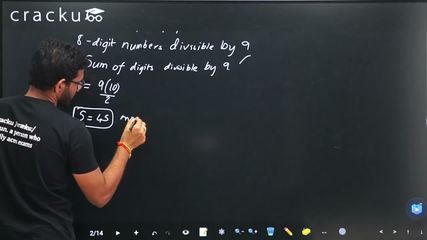
An eight digit number divisible by 9 is to be formed using digits from 0 to 9 without repeating the digits. The number of ways in which this can be done is:
First recall the rule for divisibility by 9: a whole number is divisible by 9 exactly when the sum of its digits is itself a multiple of 9.
We must form an eight-digit number with no repeated digits chosen from $$\{0,1,2,3,4,5,6,7,8,9\}.$$ Instead of choosing the eight digits directly, it is easier to decide which two digits will be left out. Once the two omitted digits are fixed, the remaining eight are automatically selected.
The total sum of all ten digits is $$0+1+2+3+4+5+6+7+8+9 = 45,$$ and $$45$$ is a multiple of $$9.$$ If the two omitted digits are $$a$$ and $$b,$$ then the sum of the chosen eight digits equals $$45-(a+b).$$ For this sum to be divisible by $$9,$$ we need $$45-(a+b)\equiv 0 \pmod 9.$$ Because $$45\equiv 0 \pmod 9,$$ the condition becomes simply $$(a+b)\equiv 0 \pmod 9.$$ Thus we must omit two distinct digits whose sum is a multiple of $$9.$
The only possible non-negative multiples of $$9$$ obtainable by adding two distinct single digits are $$9$$ itself (since $$0+0=0$$ uses the same digit twice and $$9+9=18$$ repeats $$9$$). Hence we list all distinct unordered pairs whose sum is $$9$$:
$$(0,9),\;(1,8),\;(2,7),\;(3,6),\;(4,5).$$
There are exactly $$5$$ such pairs, so there are $$5$$ different sets of eight digits whose digit-sum satisfies the divisibility condition.
Next we count, for each of these five sets, how many eight-digit numbers can be formed. We must also respect the usual rule that an integer cannot start with the digit $$0.$$ Two situations arise:
Case 1: The omitted pair is $$(0,9).$$ Here the digit $$0$$ is omitted, so each permutation of the remaining eight digits automatically starts with a non-zero digit. The number of possible arrangements is therefore $$8!.$$
Case 2: Any of the other four pairs is omitted, i.e.\ $$(1,8),(2,7),(3,6),(4,5).$$ Now the digit $$0$$ is present among the eight chosen digits. All permutations of eight distinct digits number $$8!,$$ but we must subtract the arrangements that begin with $$0.$$ If $$0$$ is fixed in the first place, the remaining seven positions can be filled in $$7!$$ ways. Hence the admissible arrangements for each such set equal $$8!-7! = 7!(8-1)=7!\times 7.$$
Combining both cases, the total count of desired numbers is
$$\begin{aligned} \text{Total}&=1\cdot 8! \;+\;4\cdot(8!-7!)\\ &=8!+4\bigl(8!-7!\bigr)\\ &=8!+4\cdot8!-4\cdot7!\\ &=5\cdot8!-4\cdot7!. \end{aligned}$$
Because $$8!=8\cdot7!,$$ we rewrite the expression:
$$5\cdot8!-4\cdot7! = 5\cdot(8\cdot7!)-4\cdot7! =(40-4)\,7! =36\,7!.$$
Thus the required number of eight-digit numbers is $$36(7!).$$
Hence, the correct answer is Option D.
Was this solution helpful?
Click on the Email ☝️ to Watch the Video Solution
Create a FREE account and get:
_1.webp)

Educational materials for JEE preparation

Ask our AI anything

AI can make mistakes. Please verify important information.
AI can make mistakes. Please verify important information.
