
Join Our JEE Preparation Group
Prep with like-minded aspirants; Get access to free daily tests and study material.
Sign in
Please select an account to continue using cracku.in
↓ →
Join Our JEE Preparation Group
Prep with like-minded aspirants; Get access to free daily tests and study material.
If $$2\tan^2\theta - 5\sec\theta = 1$$ has exactly 7 solutions in the interval $$(0, \frac{n\pi}{2})$$, for the least value of $$n \in \mathbb{N}$$ then $$\sum_{k=1}^{n} \frac{k}{2^k}$$ is equal to :
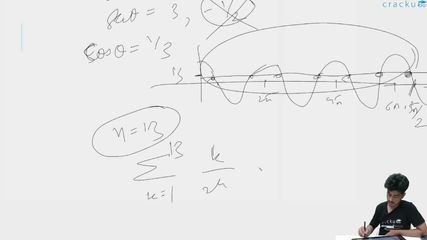
Trig Equation: $$2(\sec^2\theta - 1) - 5\sec\theta = 1 \implies (2\sec\theta + 1)(\sec\theta - 3) = 0$$.
Since $$\sec\theta \in (-\infty, -1] \cup [1, \infty)$$, we get $$\cos\theta = \frac{1}{3}$$.
Every $$2\pi$$ interval gives 2 solutions. For exactly 7 solutions, the interval must reach the $$1^{\text{st}}$$ quadrant of the $$4^{\text{th}}$$ cycle: $$[0, 6\pi + \frac{\pi}{2}] = [0, \frac{13\pi}{2}]$$. Thus, the least $$n = 13$$.
AGP Sum ($$n=13$$):
$$S = \sum_{k=1}^{13} \frac{k}{2^k} = 2 - \frac{13 + 2}{2^{14}} = \frac{1}{2^{13}}2^{14} - 15$$
Was this solution helpful?
Click on the Email ☝️ to Watch the Video Solution
Create a FREE account and get:
_1.webp)

Educational materials for JEE preparation

Ask our AI anything

AI can make mistakes. Please verify important information.
AI can make mistakes. Please verify important information.
