
Join Our JEE Preparation Group
Prep with like-minded aspirants; Get access to free daily tests and study material.
Sign in
Please select an account to continue using cracku.in
↓ →
Join Our JEE Preparation Group
Prep with like-minded aspirants; Get access to free daily tests and study material.
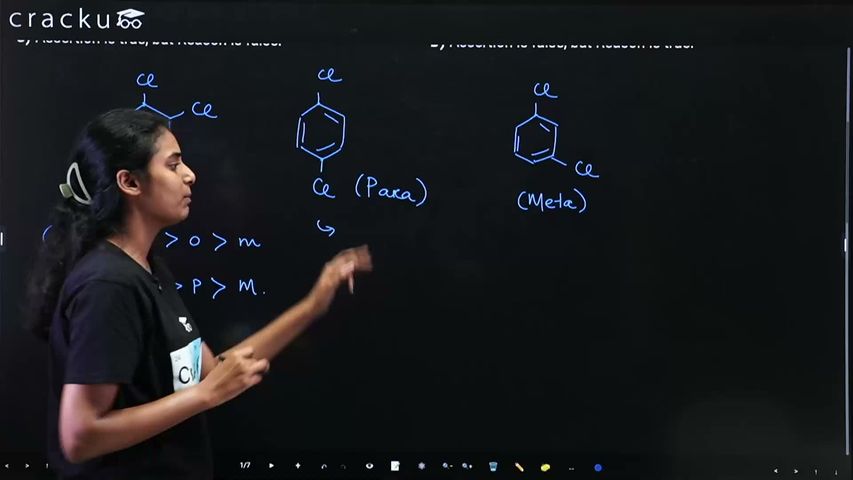
Assertion: In case of isomeric dihalobenzenes, the p-isomers have greater boiling point than the ortho and meta-isomers.
Reason: The greater symmetry of p-isomers allows them to pack more efficiently in the crystal lattice than their ortho and meta counterparts.
Choose the correct option.
The Assertion is false because the boiling points of isomeric dihalobenzenes are actually nearly identical, following the general order of ortho > para > meta. Ortho-isomers possess a higher dipole moment, which leads to stronger intermolecular dipole-dipole attractions and a slightly higher boiling point than the para-isomer. The assertion statement mistakenly applies a trend typical of melting points to boiling points.
The Reason is true because the para-isomer has a highly symmetrical structure. This structural symmetry allows its molecules to align and pack much more efficiently into a solid crystal lattice than its asymmetrical ortho and meta counterparts. Since crystal lattice packing determines the melting point rather than the boiling point, this statement is factually accurate but does not support the false assertion.
Correct option: (D)
Was this solution helpful?
Click on the Email ☝️ to Watch the Video Solution
Create a FREE account and get:
_1.webp)

Educational materials for JEE preparation

Ask our AI anything

AI can make mistakes. Please verify important information.
AI can make mistakes. Please verify important information.
