
Join Our JEE Preparation Group
Prep with like-minded aspirants; Get access to free daily tests and study material.
Sign in
Please select an account to continue using cracku.in
↓ →
Join Our JEE Preparation Group
Prep with like-minded aspirants; Get access to free daily tests and study material.
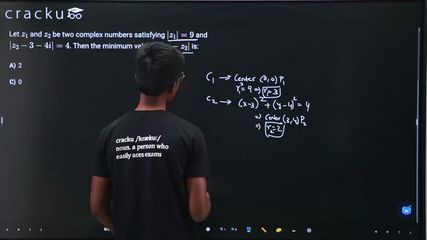
Let $$z_1$$ and $$z_2$$ be two complex numbers satisfying $$|z_1| = 9$$ and $$|z_2 - 3 - 4i| = 4$$. Then the minimum value of $$|z_1 - z_2|$$ is:
We begin by translating each modulus condition into the geometric language of the complex plane.
The equation $$|z_1| = 9$$ means that $$z_1$$ lies on the circle whose centre is the origin $$O(0,0)$$ and whose radius is $$9$$.
The equation $$|z_2 - 3 - 4i| = 4$$ means that $$z_2$$ lies on the circle whose centre is the point $$C(3,4)$$ and whose radius is $$4$$. (We see this because the standard form $$|z - z_0| = r$$ represents a circle of radius $$r$$ centred at the complex number $$z_0$$.)
We now need the minimum possible value of $$|z_1 - z_2|$$, i.e. the shortest distance between a point on the first circle and a point on the second circle.
First we compute the distance between the two centres. Using the distance formula,
$$OC = \sqrt{(3-0)^2 + (4-0)^2} = \sqrt{9 + 16} = \sqrt{25} = 5.$$
So the centres are $$5$$ units apart. Next we recall a basic fact about two circles:
If the centres are $$d$$ units apart, and the radii are $$r_1$$ and $$r_2$$, then:
• If $$d \gt r_1 + r_2$$, the circles are disjoint externally and the minimum centre-to-centre line segment left uncovered by the two radii is $$d - (r_1 + r_2)$$.
• If $$|r_1 - r_2| \le d \le r_1 + r_2$$, the circles intersect or are tangent, so the two circumferences meet and the minimum distance is $$0$$.
• If $$d \lt |r_1 - r_2|$$, one circle lies completely inside the other without touching; in that case the uncovered segment equals $$|r_1 - r_2| - d$$.
Here we have
$$r_1 = 9,\; r_2 = 4,\; d = 5.$$
We calculate the difference of the radii:
$$|r_1 - r_2| = |9 - 4| = 5.$$
Notice that
$$d = 5 = |r_1 - r_2|.$$
So we are precisely in the border case $$|r_1 - r_2| \le d \le r_1 + r_2$$ where equality holds on the left. This describes internal tangency: the smaller circle of radius $$4$$ is tangent from the inside to the larger circle of radius $$9$$. The two circles touch at exactly one common point lying on the line joining the centres.
Because that point belongs to both circles, we can take
$$z_1 = z_2$$
at the point of tangency. Consequently,
$$|z_1 - z_2| = |z_1 - z_1| = 0.$$
Since no distance can be smaller than $$0$$, this is the minimum possible value.
Hence, the correct answer is Option C.
Was this solution helpful?
Click on the Email ☝️ to Watch the Video Solution
Create a FREE account and get:
_1.webp)

Educational materials for JEE preparation

Ask our AI anything

AI can make mistakes. Please verify important information.
AI can make mistakes. Please verify important information.


